
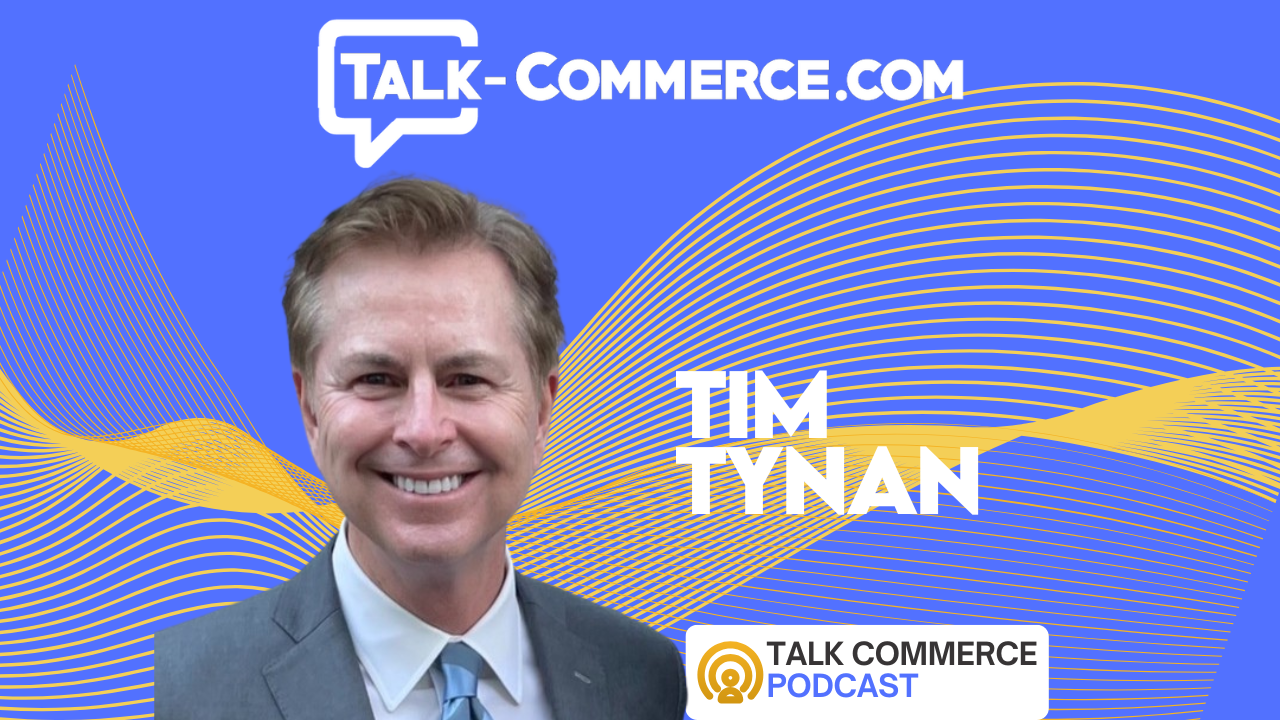
Tim Tynan Reveals How Every Chargeback Tells a Story and chargeback management Best Practices
In this episode of Talk Commerce, I had the pleasure of sitting down with Tim Tynan, CEO of Chargeback Gurus, for what turned out to be an enlightening discussion about the intricate world of chargeback management. Our conversation explored how merchants can better navigate the dispute process, the impact of Visa’s new VAMP program, and the evolving role of AI in payment processing. Tim brings decades of industry experience from companies like Bank of America and Citigroup, and he shared practical insights that could transform how merchants approach chargebacks.
Key Takeaways
• Every chargeback tells a unique story that requires investigation to understand the underlying cause
• Merchants should maintain detailed documentation and implement clear terms and conditions upfront
• The new Visa VAMP program combines fraud and chargeback monitoring into a single 1.5% threshold for merchants
• Consumer education and easy opt-out capabilities are essential for subscription-based businesses
• AI and machine learning enhance chargeback management but can’t replace human expertise entirely
• First contact for dispute resolution should always be directly with the merchant before escalating
• Quality control and accurate information remain critical factors in successful dispute resolution
About Tim Tynan
Tim Tynan serves as CEO of Chargeback Gurus, where he leads efforts to help merchants manage the complex dispute process for credit card transactions. His extensive background spans multiple decades in the financial services industry, including significant roles at Bank of America and Citigroup. Before transitioning to banking and payments, Tim worked at IBM, giving him a unique technology perspective that proves invaluable in today’s evolving payment landscape. He brings both technical expertise and operational experience to the challenge of simplifying chargeback management for merchants of all sizes. Outside of his professional responsibilities, Tim maintains a passion for baseball and enjoys spending time with his family.
Summary
I started our conversation by asking Tim how he makes chargebacks exciting – admittedly a challenge I’ve faced as someone who’s been in the industry for years. His response immediately caught my attention: every chargeback tells a story that requires investigation to understand the underlying cause. Tim emphasized that successful dispute resolution hinges on getting the right information to the right people to make informed decisions, involving coordination between multiple parties including banks, merchants, consumers, and card networks like Visa and MasterCard.
When I brought up my own frustrations as a consumer with the chargeback process, Tim strongly advocated for contacting merchants first. “The best thing and the first thing I would always do is call the merchant, call the store or the, if it’s an online, find the process,” he explained. This approach often resolves issues without escalating to formal dispute processes – something I wish more consumers understood.
I was particularly interested in learning about Visa’s new VAMP (Visa Acquire Monitoring Program), which Tim explained represents a significant change in how the industry monitors disputes. VAMP replaces two separate programs – the Visa Dispute Management Program and the Visa Fraud Management Program – consolidating them into a single monitoring system. Under the new structure, merchants face a 1.5% threshold while acquiring banks must maintain a stricter 0.7% ratio.
During our discussion about fraud prevention, Tim outlined several best practices merchants should implement upfront. These include account verification, address verification, and CVV validation. He also mentioned companies like Signify and Riskify that provide scoring mechanisms to help merchants make real-time decisions about transaction legitimacy.
Our conversation became particularly relevant when I addressed subscription business models – something I’ve personally experienced frustration with as a consumer. Tim acknowledged this as a common source of consumer frustration, noting that best practices include clear opt-out capabilities, regular reminders, and comprehensive education about terms and conditions. “Having the ability to unsubscribe is very important. Having that opt out capability is important,” he stated.
When I raised concerns about AI replacing human customer service, potentially leading to increased chargebacks, Tim provided a balanced perspective that resonated with my own observations. While acknowledging AI’s growing role in customer service and decisioning, he maintained that human expertise remains irreplaceable, especially given AI’s current limitations including hallucinations and data accuracy concerns.
Tim shared how Chargeback Gurus leverages machine learning algorithms for more effective decision-making while emphasizing the continued importance of human oversight. “It’s a combination of both that I think is the realistic approach today,” he explained, advocating for practical AI implementation rather than wholesale replacement of human processes.
Final Thoughts
My conversation with Tim revealed that effective chargeback management extends far beyond simple transaction processing. The evolution from separate fraud and dispute monitoring programs to Visa’s integrated VAMP system reflects the industry’s recognition that these issues interconnect in complex ways. I came away convinced that merchants who embrace proactive communication, maintain detailed documentation, and leverage technology wisely will find themselves better positioned to manage disputes successfully. The key lies not in eliminating human involvement but in augmenting expertise with intelligent automation. As the payments landscape continues evolving, I believe the merchants who treat each chargeback as a story worth investigating will ultimately write their own success stories in dispute resolution.
Follow Talk Commerce on your favorite platform:
- YouTube: https://www.youtube.com/@talkcommerce
- Bluesky: https://bsky.app/profile/talkcommerce.bsky.social
- Apple Podcasts: https://podcasts.apple.com/us/podcast/talk-commerce/id1561204656
- Spotify: https://open.spotify.com/show/7Alx6N7ERrPEXIBb41FZ1n
- Twitter: @talkingcommerce
- LinkedIn: https://www.linkedin.com/company/talk-commerce
- Facebook: https://www.facebook.com/talkingcommerce
- Website: https://talk-commerce.com/