
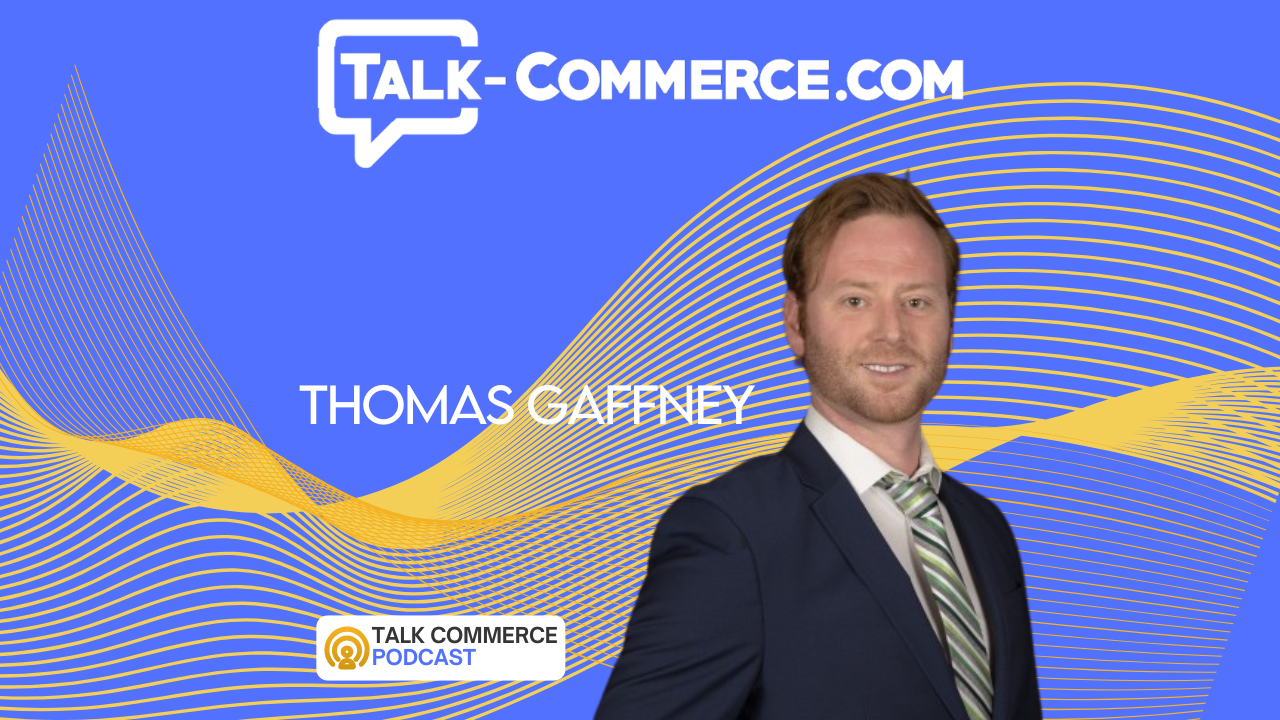
When Real Estate Meets the Blockchain — Thomas Gaffney of OFA Group on Talk Commerce
By susanmakolea
Thomas Gaffney serves as the Chief Operating Officer of OFA Group, a NASDAQ-listed company (ticker: OFAL) that started as a legacy architectural design firm and has since made a decisive pivot toward technology. OFA Group is a diversified architecture, technology, and digital-asset infrastructure company focused on AI-powered design systems, real-world asset tokenization, and next-generation financial technologies.
Episode Summary
Traditionally, a property like the Hyatt has one to five owners, and their capital is locked in. RWA tokenization changes that by placing the economic rights, appreciation, future income, profits, into a smart contract on a blockchain, then fractionalizing those rights and making them available for purchase. “If you wanted to sell 10% of the economic rights of the hotel,” Thomas explains in the episode, “you sell 100,000 tokens attributed to that RWA, and whoever holds one of those tokens owns a portion of that hotel.”
Brent draws the comparison to REITs — real estate investment trusts and Thomas confirms that blockchain transparency is the key differentiator. With on-chain distributions, everyone can see exactly how much money flows through the system, when payments happen, and how many tokens are involved. Hearth is designed as a unified, blockchain-native infrastructure system that allows qualified real estate and other income-producing assets to be validated, structured, tokenized, and managed on-chain. The platform integrates valuation tools, verification workflows, and ongoing reporting to create a transparent and standardized environment for tokenizing real-world assets.
Thomas explains that an RWA and an NFT are the same thing. Both are non-fungible tokens with unique identifiers. The difference is entirely in what they represent. A monkey JPEG and an ownership stake in a $200 million apartment building use the same underlying technology; the underlying asset is what changes everything.
Thomas revisits his paper on mortgage-backed securities and the 2008 crisis. His argument: if mortgages had been recorded on a blockchain, investors could have seen in real time which pools were healthy and which were collapsing. “In the 2008 crisis, what happened is you have a thousand mortgages in this CDO no one knew exactly what was in each one of these little pockets of securities,” he explains. That information gap is what allowed the crisis to spread as widely as it did. On-chain mortgages eliminate that gap entirely.
Thomas is measured in his claims here, which adds credibility. He doesn’t suggest blockchain would have prevented the crisis entirely, only that it would have made it “significantly less painful and significantly less severe.” That kind of nuance is worth noting in a space where overclaiming is common.
Brent also raises a question about bank adoption, and Thomas gives a practical answer. Many real estate professionals he’s spoken with are enthusiastic about blockchain as infrastructure but skeptical of cryptocurrency branding. His response is direct: you can’t fully separate the two. Blockchains that run on the internet need a means of exchange and that means stablecoins or some form of crypto token. The efficiency gains, he argues, will ultimately outweigh the institutional resistance.
COO Thomas Gaffney added that the platform is built to support both OFA and external partners from day one. “Hearth is designed so that tokenization follows a reliable, transparent process regardless of who originates the asset,” Gaffney noted.
Thomas closes with a plug for Hearth Labs, OFA Group’s RWA launchpad, and frames it in terms that resonate with anyone who’s ever watched a luxury real estate show and thought, “I’ll never be able to afford anything like that.” The goal, he says, is to let the average investor own a fraction of those $100, $200, or $400 million buildings that previously only institutional money could touch.
It’s a well-paced, well-structured conversation that earns its place as Talk Commerce’s final episode of 2025.
Final Thoughts
Thomas Gaffney makes one thing clear throughout this conversation: RWA tokenization isn’t a speculative concept waiting to find its use case. It’s an infrastructure shift already underway, and its most significant implications, in mortgage markets, real estate development, and investment access, are only beginning to surface.
The real estate market has always been about who holds the assets. Blockchain is quietly changing who gets to hold them. So the question isn’t whether RWAs will reshape real estate. It’s whether you’re paying attention while the real estate of opportunity is still available.
Connect with Thomas Gaffney on LinkedIn: https://www.linkedin.com/in/thomas-gaffney-gafftm14/
This has been produced in cooperation with Content Cucumber
https://www.contentcucumber.com/
Follow Talk Commerce on your favorite platform:
- YouTube: https://www.youtube.com/@talkcommerce
- Bluesky: https://bsky.app/profile/talkcommerce.bsky.social
- Apple Podcasts: https://podcasts.apple.com/us/podcast/talk-commerce/id1561204656
- Spotify: https://open.spotify.com/show/7Alx6N7ERrPEXIBb41FZ1n
- Twitter: @talkingcommerce
- LinkedIn: https://www.linkedin.com/company/talk-commerce
- Facebook: https://www.facebook.com/talkingcommerce
- Website: https://talk-commerce.com/