
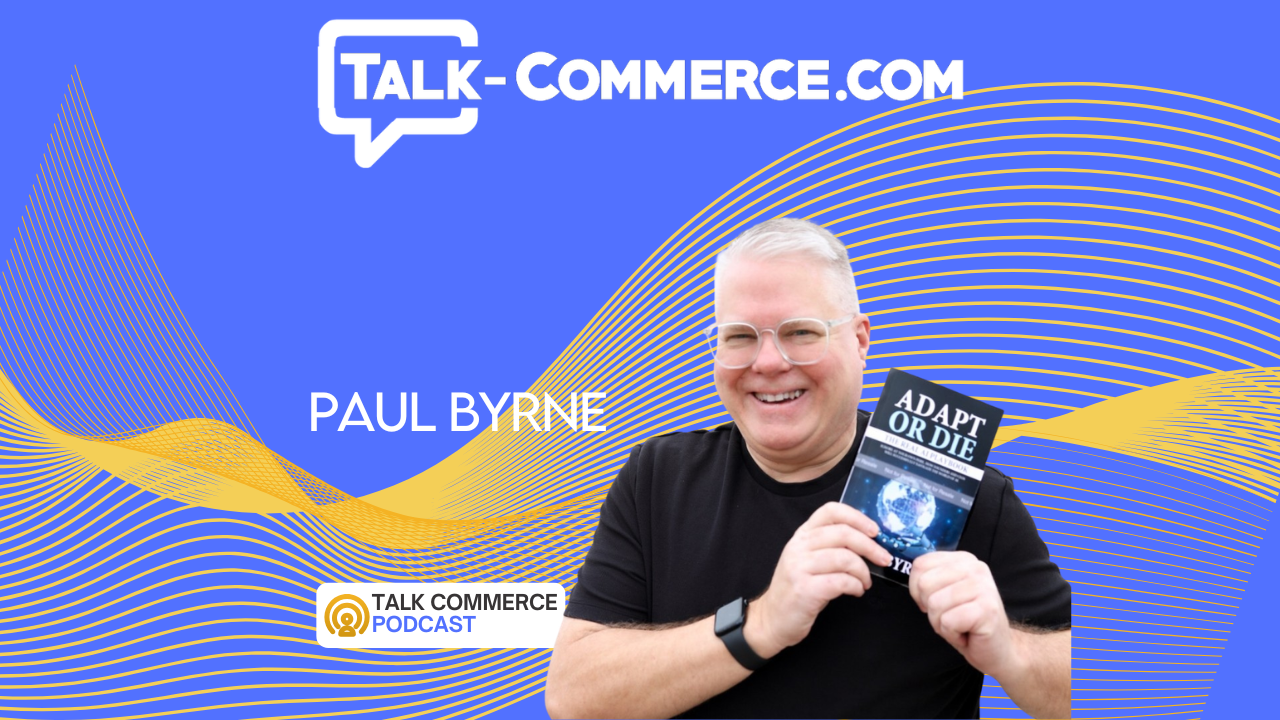
Adapt or Die: AI's Real Impact on Ecommerce Development with Paul Byrne
Brent Peterson recently sat down with Paul Byrne on a special AI edition of Talk Commerce to discuss what businesses actually need to know about artificial intelligence. Paul, the President and Founder of Razoyo and author of the newly released “Adapt or Die: The Real AI Playbook,” brought a grounded perspective to a conversation that too often gets lost in hype.
The Book That Started With a University Classroom
Paul didn’t set out to write a book. He started by teaching digital commerce students at the University of North Texas, where he found himself researching AI to answer their questions. That research, combined with conversations he was having with Razoyo’s clients, revealed a pattern. Business leaders were sitting on the sidelines, unsure whether their current projects would deliver ROI or get swallowed by AI capabilities.
So Paul wrote “Adapt or Die” specifically for founders, CEOs, and product owners who don’t have AI experts on staff. The goal was straightforward. Give decision-makers a framework to evaluate where AI fits and where it doesn’t.
Type 1 Versus Type 2 Thinking Changes Everything
One of the central concepts in Paul’s book is the distinction between Type 1 and Type 2 thinking. Type 1 is reactive. Think of it as answering a multiple choice question you’ve seen before. You don’t need to deliberate. You just respond. That’s essentially what today’s large language models do. They predict the most acceptable answer based on training data.
Type 2 thinking requires planning, persistent memory, and goal-seeking behavior. It’s the kind of thinking you engage when you encounter a problem you’ve never seen before. AI hasn’t reached this level yet. Paul follows researcher Yann LeCun, formerly of Meta’s AI division, who argues that current LLMs represent a productive but limited off-ramp from the broader AI research path.
Understanding this distinction matters for business leaders because it directly affects investment decisions. If your project relies on capabilities that require Type 2 thinking, you’re going to need humans in the loop for the foreseeable future.
Claude Code Is Changing Developer Workflows
Both Brent and Paul agreed that Claude Code represents one of the most impactful AI tools available to developers right now. Razoyo’s CTO has built agents using Claude Code that handle automated code review, checking for security vulnerabilities and performance issues before a human ever looks at the code.
However, Paul was clear about the limits. Claude Code doesn’t mean you can replace ten developers. It means your senior developers and team leads can move faster, especially on tasks that involve repetition. Code review, for instance, involves a lot of pattern checking that AI handles well. That frees up humans to focus on architecture decisions and creative problem-solving.
Brent shared his own experience building Claude Code workspaces with sprint management and retrospectives. He also shared a cautionary tale about AI deleting roughly 1,000 files from his system when he asked it to clean up a folder. The lesson there is clear. AI tools require guardrails.
The Human Slider Concept
Paul introduced what he calls the “human slider,” a design principle Razoyo now applies to its software development. As AI becomes more capable in specific areas, you gradually increase its responsibilities while maintaining human oversight at critical points. Razoyo is applying this concept to a new B2B customer service messaging product that uses AI to bring context to human agents rather than replacing them.
Agency Pricing and the Cost Question
On the business side, Paul addressed a question many clients ask. Will AI bring down development costs? The short answer is no, not in the way people expect. Developers accomplish more in less time, but the expertise required to use AI tools effectively comes at a premium. Razoyo is moving toward fixed-price models on more projects to reflect this shift.
Paul also raised a concern that doesn’t get enough attention. Most AI providers are currently losing money. OpenAI is, by some accounts, approaching financial distress. When these companies start charging what it actually costs to generate tokens, businesses that have built dependencies on these tools could face significant cost increases.
Predictions Worth Questioning
Both Brent and Paul pushed back on bold industry predictions. The idea that websites will disappear in favor of AI-powered shopping, or that software engineering will be fully automated within a year, doesn’t hold up under scrutiny. Paul compared it to the prediction that brick-and-mortar retail would vanish. It didn’t. Formats persist because they serve real needs.
You can pick up “Adapt or Die: The Real AI Playbook” on Amazon now. Paul mentioned he’s already working on a second book, and he’ll send a signed copy to anyone who reaches out to Razoyo about development work.
? Get “Adapt or Die: The Real AI Playbook” on Amazon: https://www.amazon.com/Adapt-Die-Playbook-Founders-Successfully-ebook/dp/B0GHPBGM7C ?
Learn more about Razoyo: https://razoyo.com
This has been produced in cooperation with Content Cucumber
https://www.contentcucumber.com/
Follow Talk Commerce on your favorite platform:
- YouTube: https://www.youtube.com/@talkcommerce
- Bluesky: https://bsky.app/profile/talkcommerce.bsky.social
- Apple Podcasts: https://podcasts.apple.com/us/podcast/talk-commerce/id1561204656
- Spotify: https://open.spotify.com/show/7Alx6N7ERrPEXIBb41FZ1n
- Twitter: @talkingcommerce
- LinkedIn: https://www.linkedin.com/company/talk-commerce
- Facebook: https://www.facebook.com/talkingcommerce
- Website: https://talk-commerce.com/