
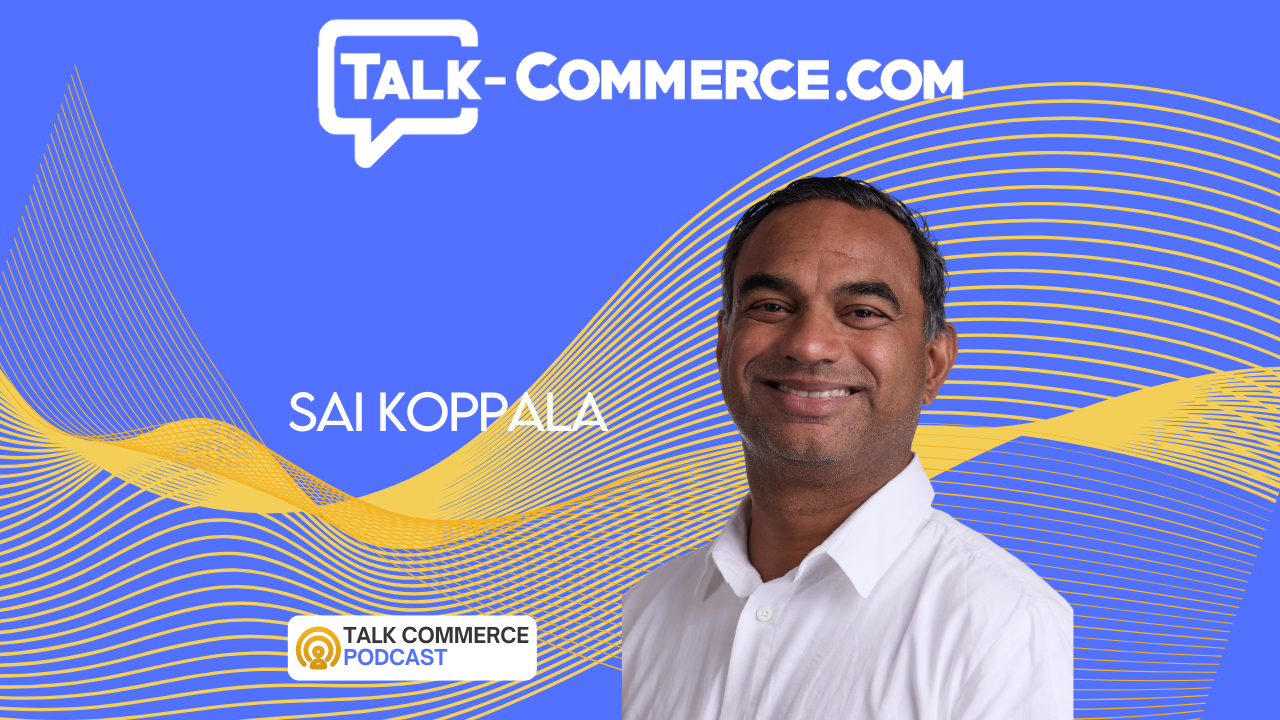
AI Agents Are Reshaping Retail Media for CPG Brands with Sai Koppala
Welcome back to another episode of Talk Commerce with Brent Peterson. In this episode, Brent sits down with Sai Koppala, the Chief Marketing Officer at CommerceIQ, to discuss how AI agents are transforming the way consumer packaged goods brands manage retail media spend, digital shelf optimization, and sales. The conversation covers everything from the rise of agentic AI in retail to go-to-market strategy shifts and economic predictions for the year ahead. If you’re a brand leader trying to make sense of the rapidly evolving AI landscape in e-commerce, this episode delivers practical insights you won’t want to miss.
Key Takeaways
- AI agents are now table stakes in retail. Retailers like Amazon and Walmart have automated buy box decisions, keyword bidding, and share of voice. Brands that rely solely on human analysts and agencies can’t keep pace.
- Retail media spend is up, but efficiency is down. According to CommerceIQ’s own research, retail media spend rose 20% while return on ad spend dropped roughly 8%. AI-driven optimization can execute over 4,000 automations per day compared to a few hundred with rules-based tools.
- Long-tail keywords are the new frontier. As consumers shift to conversational, Q&A-style search through agents like Rufus and Spark, brands must optimize content for natural language queries, not just traditional keywords.
- Context is what separates real AI from AI washing. Training LLMs with macro, category, and brand-level context is what produces sound business decisions. Without that layered context, models simply hallucinate.
- Free pilots beat long sales cycles. CommerceIQ now offers no-cost pilots so brands can validate AI-driven results before committing, a direct response to widespread skepticism in a market flooded with AI claims.
- The K-shaped economy continues to define consumer behavior. Price-sensitive buyers hunt for everyday value, while higher-income consumers will pay more for premium products. Brands need strategies that address both segments.
Episode Summary
The conversation opened with Sai providing a clear overview of CommerceIQ’s mission. He explained that the company works primarily with CPG brands worldwide, helping them optimize retail media spend, digital shelf presence, and overall sales through a combination of AI agents and human expertise.
Brent then steered the discussion toward AI agents and their current state in retail. Sai offered a grounded perspective, noting that retailers have already automated significant portions of their operations. He pointed to Amazon’s Rufus and Walmart’s Spark as examples of consumer-facing agents that are changing product discovery. “It’s no longer your website or your product description page is the front door. It’s actually these agents,” Sai noted, underscoring the urgency for brands to respond with their own automation capabilities.
The discussion moved into retail media efficiency, where Sai shared data from CommerceIQ’s 2025 e-commerce report. He highlighted that while spend increased across the board, returns diminished. AI-powered optimization addresses this gap by leveraging 50-plus signals, including real-time share of voice, inventory availability, and keyword performance, to make thousands of bid adjustments daily. Still, Sai emphasized that humans remain essential for strategic decision-making. “The strategic aspects of it still is human driven. So you need a combination of both,” he said.
Long-tail keyword optimization emerged as a significant theme. Sai explained that consumer search behavior has shifted toward natural, conversational queries. This shift forces brands to rethink their content strategies so that AI agents on retail platforms surface their products effectively.
When Brent asked about CommerceIQ’s go-to-market evolution, Sai described a meaningful transformation. The company moved from pure analytics, telling brands what happened, to prescriptive recommendations and automated execution. To combat AI washing in the market, CommerceIQ now leads with free pilots. “We believe in our technology so much that we are using essentially a free pilot for people to try out the product,” Sai shared.
One of the most insightful moments came when Sai discussed the importance of context in AI. He described how CommerceIQ trains its models with macro-level economic signals, category-specific trends, and individual brand priorities. Without this layered understanding, even the most powerful LLM functions like, as Sai put it, “a really powerful intern” that lacks the judgment to make sound business decisions.
The episode wrapped with Sai’s economic outlook. He described a K-shaped economy where brands must simultaneously serve price-conscious consumers seeking everyday value and higher-income buyers willing to pay for premium quality.
Final Thoughts
This episode paints a clear picture of where retail media and AI intersect today. Sai Koppala’s insights remind us that technology alone doesn’t win markets. It’s the combination of intelligent automation, deep contextual understanding, and human strategic oversight that drives results. As brands navigate an increasingly automated retail environment, the question isn’t whether to adopt AI agents. The real question is whether your commerce IQ is high enough to deploy them effectively.
This has been produced in cooperation with Content Cucumber
https://www.contentcucumber.com/
Follow Talk Commerce on your favorite platform:
- YouTube: https://www.youtube.com/@talkcommerce
- Bluesky: https://bsky.app/profile/talkcommerce.bsky.social
- Apple Podcasts: https://podcasts.apple.com/us/podcast/talk-commerce/id1561204656
- Spotify: https://open.spotify.com/show/7Alx6N7ERrPEXIBb41FZ1n
- Twitter: @talkingcommerce
- LinkedIn: https://www.linkedin.com/company/talk-commerce
- Facebook: https://www.facebook.com/talkingcommerce
- Website: https://talk-commerce.com/