
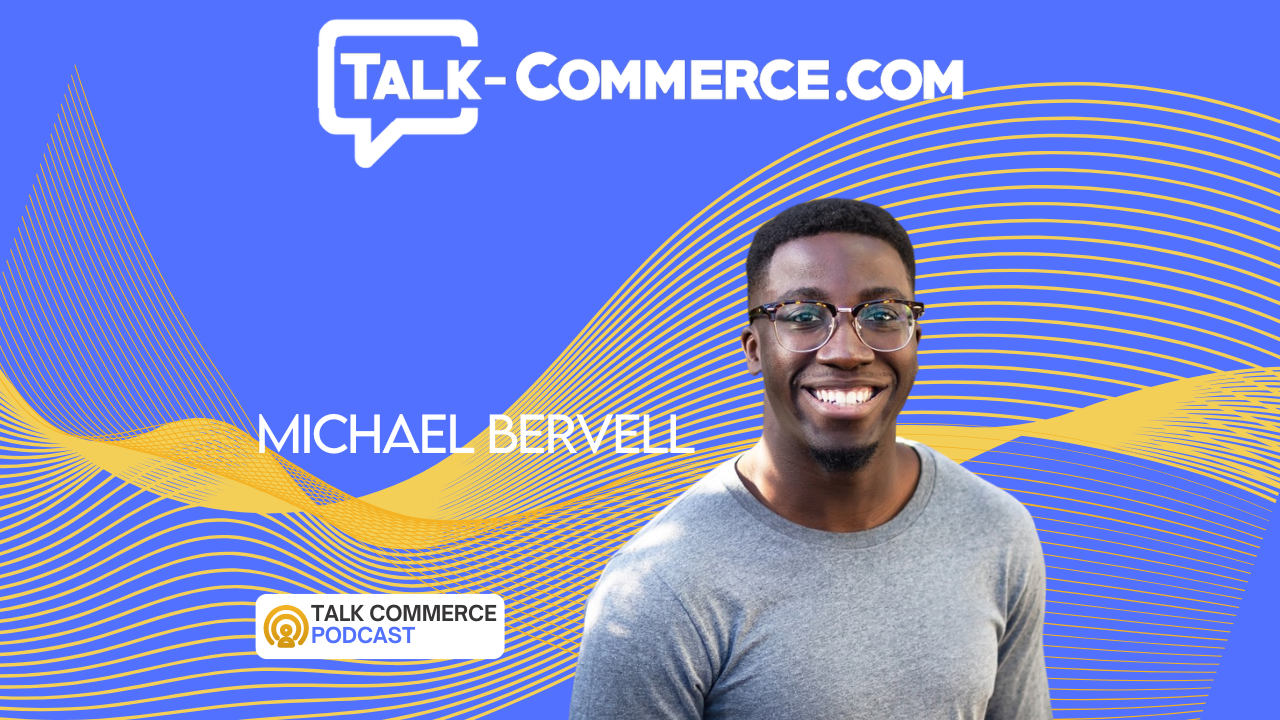
Michael Bervell and Test Party Are Fixing Web Accessibility for E-Commerce
Host Brent Peterson sits down with Michael Bervell, founder and CEO of Test Party, to discuss one of the most overlooked challenges facing online businesses today—web accessibility. TestParty is a human-first digital accessibility compliance platform powered by AI. From personal experiences with product exclusion to building a company that now serves close to 55 e-commerce clients, Michael shares his journey and breaks down why accessibility isn’t just a legal checkbox—it’s a business imperative. Along the way, the conversation covers AI’s role in development, the risks of ADA lawsuits, and what e-commerce entrepreneurs should expect in the year ahead.
Key Takeaways
- Accessibility is product inclusion. Michael frames accessibility as a subset of product inclusion—the practice of designing digital products so that the default usage pattern works for the widest range of people, regardless of ability.
- 97% of the web is not accessible. That’s a staggering number. Because AI coding tools are trained largely on inaccessible website data, they tend to produce inaccessible code by default. Developers need to actively prompt for accessibility or use deterministic tools.
- ADA lawsuits are real and growing. “800+ businesses using automated overlay tools” were sued in 2023–2024. “Drive-by” lawyers are scanning websites and filing lawsuits against non-compliant businesses, including many built on Shopify, WooCommerce, and WordPress.
- Automated tools catch only about 60% of issues. The remaining 40% requires manual testing and user testing. Businesses should not rely solely on automated scans.
- Test Party doesn’t just test—it fixes. The company’s biggest differentiation in the market is its ability to take audit results and automatically remediate code at the source level, rather than leaving business owners with a report they don’t know how to act on.
- Disability is fluid. Michael explains that physical ability changes throughout one’s life—whether it’s holding a baby with one arm, recovering from Lasik surgery, or using crutches after an injury. Designing for these temporary states benefits everyone.
- International founders offer lessons American entrepreneurs often miss. Through his bestselling book Unlocking Unicorns, Michael studied billion-dollar founders in Asia, Africa, and the Middle East—and found that concepts like “leapfrogging” infrastructure can create opportunities American business culture tends to overlook.
- Niche AI tools will dominate the near future. Michael predicts that 2025 and 2026 will see further “unbundling” of AI use cases, leading to hyper-specific tools for SEO, conversion optimization, A/B testing, and accessibility.
Episode Summary
Michael recounts a formative experience from sixth grade: he received an Xbox Kinect as a Christmas gift, and the device didn’t recognize his skin tone. “We plugged it in and it didn’t recognize our skin tone,” he recalls. That moment planted the seed for what would become a career focused on product inclusion.
TestParty automatically scans and fixes source code to create more accessible websites and media, reducing risk and supplementing in-house or manual vendor audits. TestParty provides actionable fixes directly in your source code editor or tools—no coding required, no extra tests to write. Michael compares the product to Sentry (for security errors), noting that Test Party is essentially the accessibility version—finding the issue and resolving it within the developer’s existing workflow.
Michael book, Unlocking Unicorns features diverse stories from successful billion-dollar startup founders in Africa, Asia, and the Middle East Written during the COVID lockdowns, Bervell researched founders like Jack Ma of Alibaba, Bang Si-hyuk behind BTS, and the co-founder of Careem in the Middle East. He highlights the concept of “leapfrogging,” where emerging economies skip legacy infrastructure entirely and build on modern technology from day one. “If I were to go launch a company in Africa today, it actually would be, in some respects, easier than launching it in the US depending on which industry I’m choosing,” he states.
Looking ahead, Michael sees further unbundling of AI capabilities. General-purpose tools like ChatGPT will give way to specialized solutions—automated A/B testing platforms, simulated user-flow tools, and niche accessibility engines. “You used to go to ChatGPT for everything. Now you go to Perplexity for search, ChatGPT for writing your emails, and Claude for your code reviews,” he observes.
Final Thoughts
This episode of Talk Commerce delivers a clear message: accessibility is not a nice-to-have—it’s a strategic business function that affects revenue, legal exposure, and brand trust. Michael Bervell brings a rare combination of philosophical thinking, venture capital experience, and hands-on startup execution to the table. His work with Test Party proves that finding problems is only half the job; fixing them is what matters.
The question every e-commerce business owner should ask: Is your website truly accessible, or are you just hoping nobody tests the party?
This has been produced in cooperation with Content Cucumber
https://www.contentcucumber.com/
Follow Talk Commerce on your favorite platform:
- YouTube: https://www.youtube.com/@talkcommerce
- Bluesky: https://bsky.app/profile/talkcommerce.bsky.social
- Apple Podcasts: https://podcasts.apple.com/us/podcast/talk-commerce/id1561204656
- Spotify: https://open.spotify.com/show/7Alx6N7ERrPEXIBb41FZ1n
- Twitter: @talkingcommerce
- LinkedIn: https://www.linkedin.com/company/talk-commerce
- Facebook: https://www.facebook.com/talkingcommerce
- Website: https://talk-commerce.com/