
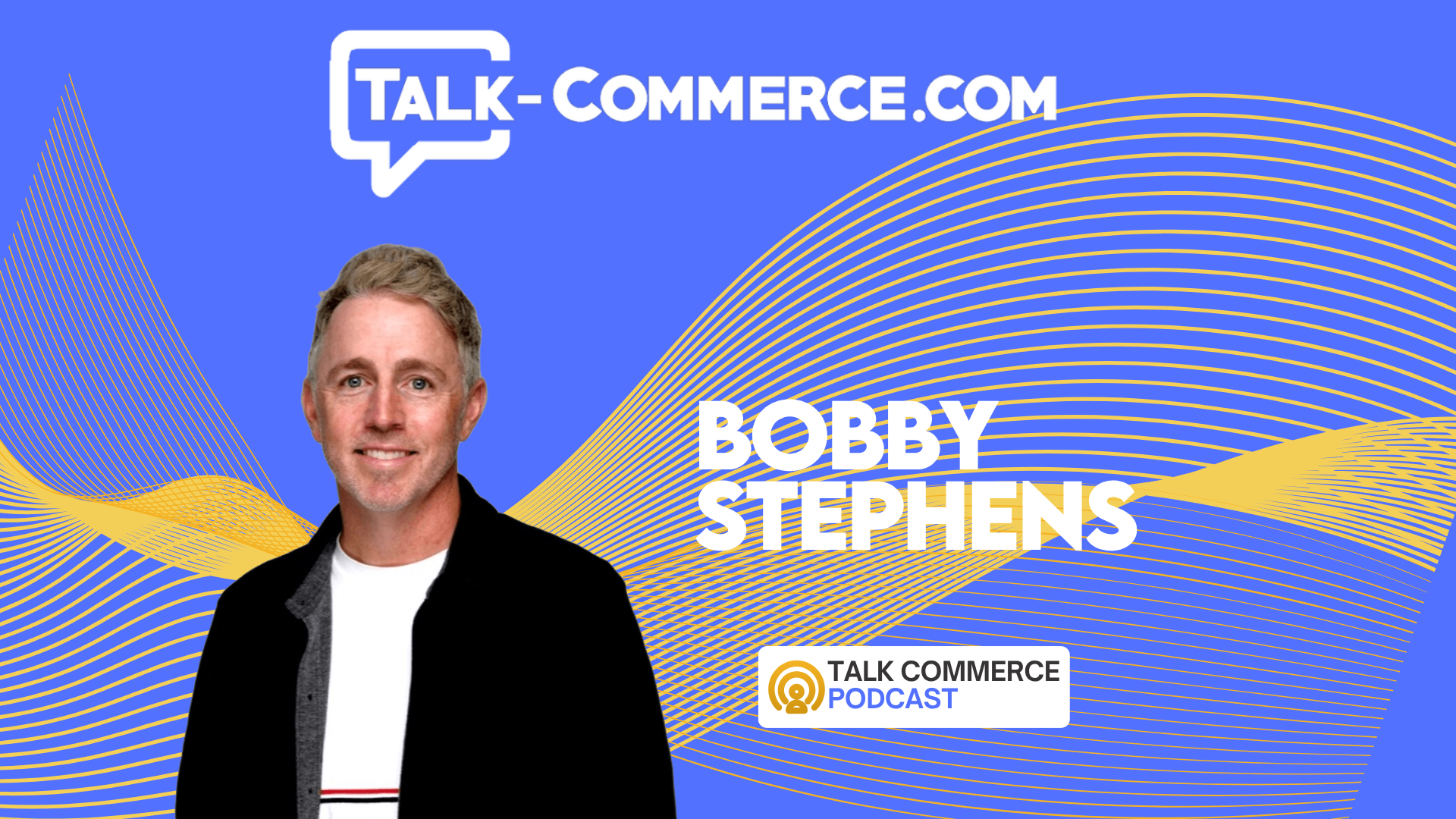
Customers Compare You to Every App on Their Phone with Bobby Stephens of Deloitte Digital
Watch the Episode
Bobby Stephens leads the US retail and CPG practice at Deloitte Digital, and he came on right after his team put out their 2026 B2C commerce report, which surveyed 550 commerce leaders and 1,000 consumers and came back with the two groups describing what sounds like two different businesses. We recorded the first week of September, with his Hoosiers opening a season worth being excited about and my Vikings shirt already picked out for a Packer bar here in Kona, and then we spent the rest of the time inside the gap his data turned up.
“I think commerce now sits at the center of the customer relationship,” he says. “I don’t think it’s just a transactional channel anymore.”
The Divide Is in the Table Stakes
I expected the headline finding to be about something new and complicated. It was the opposite, and that is what makes it worth sitting with.
“The headline is that there’s a meaningful divide between what brands believe they’re delivering from a commerce experience and what customers are saying they actually are experiencing,” he says. “And that divide is important.”
The gap showed up in the parts of the business that have been solved for a decade, or that everyone assumed were solved. Finding the product, confirming it is in stock, checking out, getting an order update, making a return.
“It’s shocking, but customers still think it should be easier than merchants make it,” he says. “Or said better, merchants think they’re doing a better job at checkout than customers think they are.”
His point about why this persists is the one I would put in front of a leadership team. The capability exists. The experience of the capability does not match.
“Those capabilities are technically live probably for every retailer, but customers are experiencing it as hard to find or inconsistent or inaccurate,” he says. “Retailers don’t have a great way of measuring some of those things through customers’ eyes.”
And the pressure on all of it went up, because the dollar got harder to win.
“57% of consumers told us that they are spending less than they did a year ago,” he says. “You’re really competing for what is a harder and harder dollar and a harder and harder piece of trust from your consumers. It’s really important that every interaction has the chance to earn that customer’s next purchase.”
Customers Compare You to Every App on Their Phone
I asked him where the gap comes from, since the brands he works with have plenty of smart people pointed at this. He gave two reasons, and the second one reframed the whole conversation for me.
“As businesses and marketers, we have a tendency to look for positive signs that we’re doing a good job and delivering on what it is we’re supposed to be doing, because we’re incented that way,” he says.
That first one I have watched happen. The second one is the trap underneath it.
“We sometimes forget that customers are comparing their experiences to all of their experiences, not just the experiences they get with your direct competitors,” he says. “Sometimes retailers or consumer products companies get a little myopic and say, hey, if we just beat the bad guy next door, we’re fine.”
The bar is being set somewhere else, by companies that are not in the category and are not trying to sell what you sell.
“Consumers are putting that up against experiences they have with LLMs, or with hotels, or with apps on their phone that are just meant for fun but are really streamlined and engaging,” he says. “Thinking a little bit about the broader set of experiences that you’re competing against is hard, but it’s really important.”
Nobody Can Tell Who Is on the Other Side of the Keyboard
I asked about the attribution gap, because the old way of measuring search worked and the new way is not built yet. He agreed there is a gap, and then made it bigger than I had framed it.
“The direct keyword search to then traffic on a site or in an app, that’s relatively established and fairly well trusted and pretty accurate,” he says. “As you’re doing different types of searches on an LLM, that’s harder to say what the prompts are that you’re gonna expect out of a customer when it’s more of a two-way conversation.”
The second half is the part that reaches into the money.
“As those chat platforms are sending more and more bots, agents, whatever word you want to use, out onto sites to find things, it’s harder to tell what percentage of your audience is actually a human being on the other side of the keyboard versus an agent or a bot,” he says.
Which lands on anyone selling audiences.
“If you think about companies that have retail or commerce media networks and they’re selling audiences, can I guarantee you that the audience you’re getting is actually a human being as well?” he says. “That will matter less when agents can make purchases. As of right now, still human in the loop is important.”
Ten to Twelve Percent Is the Real Agentic Number
For all the noise about agentic commerce, his survey put a number on how much of it has reached the customer, and it is small.
“About 10 to 12% of companies are currently saying that they really use agentic AI extensively to power their customer facing commerce,” he says.
Where AI is landing instead is inside the building.
“AI I think is impacting B2C commerce more today from a productivity perspective, meaning the most common use cases right now are more focused on the brand back to their own associates,” he says. “Whether that’s analytics, whether that’s more efficiency in terms of content, personalization. How many variations of one campaign could a person come up with versus something that’s a little more AI powered?”
He expects that number to look different in a year.
“If we were to talk this time next year, you’d see that number be a lot higher,” he says. “But I think we’re in the learning part of the cycle right now.”
On the blocking and tackling side, he named what the large consumer facing brands are working through now, which is making content machine readable and getting loyalty and rewards visible inside the LLMs, because points are a reason to buy the same product from you instead of the other place that carries it.
The Sizzle Around the Segment of One
I brought up hyper personalization and micro segmentation, which I had been hearing about at eTail a couple of weeks earlier. He was cooler on it than most people I talk to.
“I think there’s a lot of sizzle, if you will, to the one to one personalization or segment of one kind of headline,” he says. “I’m not sure that that’s scalable, nor is it maybe even the most efficient way to market.”
His alternative is less exciting and more useful.
“It’s better to get more accurate with the segments that you have and be better at measuring the value that they can contribute than trying to get more and more precise down to the one to one level,” he says.
He also drew a line on what personalization is for, which is a line worth keeping.
“How do retailers build a short list of those use cases that are really visible and really helpful to the customer, not just targeted at getting you to the highest margin item or the thing we got the most of right now?” he says. “Start with that clean, fully consented first and zero party data, and prove those values in a few journeys, and then you can scale from there.”
When I asked whether retailers or brands are further along, he gave it to the retailers, and the reason is structural rather than about talent. Retailers sit at the point of purchase, they run the loyalty program, some of them issue the credit instrument, and they have interactions with a customer that are not a transaction.
“They just have a lot more data that they can knowingly and accurately attribute to a particular person or household,” he says.
Where Agentic Buying Lands First
Meta had announced a buying agent the week we recorded, so I asked whether brands are getting ahead of a non human buyer. He flagged this one as opinion rather than data, and then made a call I have not heard put in these terms.
“You will see some experimentation with this much more in the B2B environment than you will in the B2C environment,” he says. “Company A sells a commodity product to big company B who is a dealer of that product. We have contracts that govern them. We have volumes. We have history. Those are things that we might be comfortable doing more agent to agent communication, negotiation, and transaction.”
On the consumer side he expects a narrow set of people to go first.
“It’s gonna be a very small and very risk tolerant human set of consumers that are gonna be willing to try that out in the beginning,” he says.
I put my own bet on the table, which is that subscriptions go first, because a consumable with a known price and a known reorder date is the one purchase where handing the decision to an agent costs you nothing. You are not asking a bot to pick your running shoes.
The Website Is Not Going Anywhere
The idea that the website disappears has been circulating for a couple of years and I have been a skeptic the whole time, so I asked where he lands.
“I tend to agree brands are not going to want to give up control of their brand, control of their product catalog,” he says.
His second reason is the one people forget, which is that the website is the plumbing for everything else.
“There’s some infrastructure that is provided, generally speaking, by a website that feeds a lot of other already existing channels,” he says. “Whether it’s a product feed to your advertising or social partners, whether it’s some of your APIs that feed your branded mobile app. So that commerce infrastructure is now permeated across a broader set of channels and use cases.”
It moves out of the center without going away.
“It may not be the central channel anymore, and that might be okay for retailers or consumer products companies. They might want you to go to their app first,” he says. “I don’t see a near term world, at least while I’m still working, where it goes away completely.”
Save Me Time Save Me Money
When I asked what is coming, he described a shift that stops short of the version people keep predicting.
“The next big shift is somewhere in that neighborhood of a world where at least your agents are assisting you, helping you discover, compare, decide, and maybe in some rare cases transact,” he says. “The commerce business has to work across and effectively be thought of across these different interfaces, and be ready for customers who may arrive with all kinds of different context and expectations, with a pretty smart assistant in the co-pilot seat.”
What he tells merchants to do about it is unglamorous and specific.
“It’s gonna start with preparation. Accurate structured product and inventory data, clear policies, strong content that’s machine readable, and a real value proposition as to why you should buy from me, not from the other options,” he says. “The lucky winners there will probably experiment and focus on customer benefit, not over invest right up front, and not chase every new capability.”
And the thing that decides whether any of it works on a consumer turns out to be the same thing it has been since ecommerce started.
“Like we saw with ecommerce or mobile apps, if there is a clear link, real or perceived, for the consumer to save me time, save me money, best case save me both, then you’ve got yourself a winning proposition,” he says. “Find the best thing, find the coolest thing, those will come with time, but the same save me time, save me money is still the winner.”
I did try for a Black Friday hot take. He declined with a good reason.
“I don’t want to get ahead of Deloitte,” he says. “We generally put out a really good report on that coming up here pretty soon. I would have been frustrated if some of my colleagues threw out some random stuff prior to me putting that out there.”
Bobby’s Shameless Plug
He took two.
The first is the report we spent the episode on, Bridging the commerce divide, published in July 2026. The full findings, the methodology, and the implications for consumers and commerce leaders are in there.
The second is his own show, That Makes Sense, with sense spelled like pennies, C E N T S. It is on the major podcast platforms and covers the consumer industry with a guest from outside Deloitte most weeks.
The best place to reach him is LinkedIn, where he says he is on there every day, every hour, pretty much.