
Constructor Launches Commerce AEO to Tie AI Shopping Traffic to Sales
Constructor says its new Commerce AEO product follows shoppers referred by AI answer engines from the first click to the purchase, then suggests the product data and content fixes most likely to lead to sales.
Constructor, a San Francisco product discovery platform, announced Commerce AEO on November 19, 2026. The company says the solution helps retailers show up more often in shopping recommendations from AI answer engines and turn that visibility into sales. Constructor positions it against generalist answer engine optimization (AEO) tools, which it says stop at measuring citations and clicks.
The measurement gap behind AI shopping traffic
Shoppers are turning to AI answer engines such as ChatGPT and Claude, along with personal assistant agents such as Muse and Instinct, to discover and research products, according to Constructor. The company points to Adobe data showing that traffic from AI platforms to U.S. retail websites grew 71% year over year in September 2026.
Retailers have trouble connecting that traffic to revenue. A recent study reported by PYMNTS found that 37% of ecommerce merchants could identify visits originating from AI platforms but then lost track of those shoppers and could not determine whether the visits resulted in sales.
“Not all AI visibility is created equal. A retailer might appear again and again in AI-generated recommendations, but if those shoppers aren’t buying, what is that visibility really worth? Retailers need to know which AI-driven visits actually lead to purchases, and how they can increase those visits and make shoppers more likely to buy. They also need insight into the full purchase journey—and they need a partner that can help them increase traffic from agentic sources and increase the purchases coming from that traffic. That’s what we’re helping retailers do with Commerce AEO.”
Eli Finkelshteyn, CEO, Constructor
What Commerce AEO does
Constructor describes four capabilities in the product.
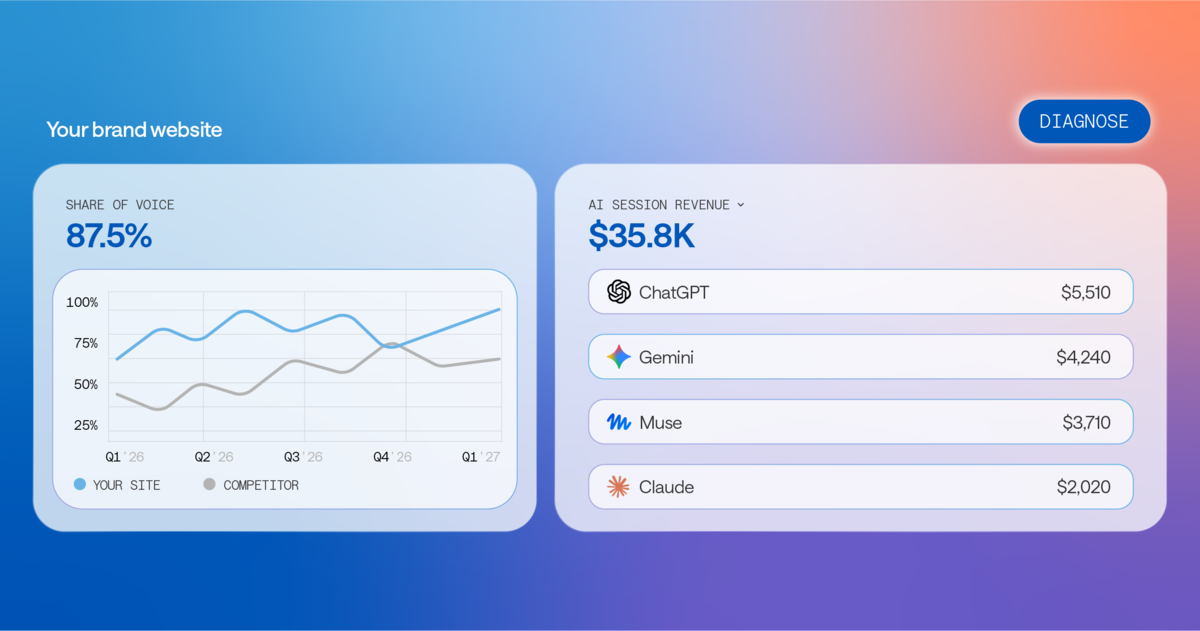
- AI traffic tied to revenue. Retailers can track shoppers referred by AI answer engines and visits from personal AI agents such as Muse and Instinct, following each journey from first click to purchase. Constructor says retailers can compare traffic across AI sources, see which products and categories generate add-to-carts and sales, and find which AI shopping queries and topics convert best.
- AI visibility tracking. The product monitors where and how often a retailer’s products appear in AI-generated answers, which competitors appear alongside them, and how that visibility changes over time, including share of voice across product categories and topics.
- Product discoverability fixes. Commerce AEO identifies problems that may prevent AI platforms from finding, understanding or recommending a retailer’s products, then suggests fixes such as adding missing or suggested product attributes or more detailed product information. Constructor says it prioritizes the fixes most likely to lead to purchases based on shopper behavior.
- AI-optimized content at scale. Retailers can use the product to create product descriptions, FAQs, buyer guides and other content aimed at showing up more often in AI-generated answers. According to Constructor, that content draws on the retailer’s own shopper behavior and purchase data to target the questions and topics most likely to lead to sales.
Constructor’s example, running shoes for flat feet
The release walks through a sporting goods retailer whose sneakers appear often in AI recommendations for “best running shoes.” In Constructor’s example, a narrower query such as “best running shoes for flat feet” leads to more purchases, even though the retailer is cited less often for it. Commerce AEO could then flag missing or incomplete product details, point to content opportunities around arch support and stability, and help the retailer generate product descriptions, FAQs and buying guides aimed at those higher-value recommendations.
The data Constructor says it brings
Constructor argues that generalist AEO tools measure AI visibility and share of voice but lack insight into what happens after shoppers arrive on a retailer’s site, and lack the ability to motivate shoppers to buy. The company says it draws on petabytes of shopper behavioral data and its experience powering personalized product discovery across websites, mobile apps, emails, texts and in-store experiences. Commerce AEO adds offsite AI discovery to that picture.
The company lists three advantages it says carry into the product.
- The Commerce Reasoning Engine. Constructor says its Commerce Reasoning Engine® powers hundreds of billions of personalized product discovery experiences each year, learning which products appeal to which shoppers, in what context and at what time.
- Shopper behavior data. Constructor draws on clicks, adds-to-cart and purchases, data it says generalist AEO tools do not have access to.
- Related product tools. Constructor offers product attribute enrichment, shopper-relevant FAQs generated by its Product Insights Agent, and targeted product collections built for each shopper individually.
What merchants can take from the announcement
Constructor’s pitch to merchants centers on attribution, linking AI referrals to add-to-carts and sales so a retailer can decide which queries and products get the next round of product data and content work. The flat feet example shows the trade-off the company is pointing at, where a less-cited query can carry more purchase intent than a broad one.
Talk Commerce has not tested Commerce AEO, and the capability and performance claims in this article are Constructor’s own. Product details are on the Commerce AEO page.
About Constructor
Constructor describes itself as an AI-driven search and product discovery platform whose central reasoning engine uses reinforcement learning to improve with each shopper interaction. The company says it is purpose-built for ecommerce and reports consistent $10M+ lifts for brands including Sephora, Petco, The Very Group, home24, Grove Collaborative and Fisheries Supply.
Questions about Constructor Commerce AEO
What is Constructor Commerce AEO?
Commerce AEO is a solution from Constructor, announced November 19, 2026, that helps retailers appear more often in shopping recommendations from AI answer engines and connect those AI-referred visits to purchases. Constructor says it tracks AI visibility, ties AI traffic to revenue, suggests product discoverability fixes and generates AI-optimized content.
How does Commerce AEO connect AI traffic to sales?
According to Constructor, it tracks shoppers referred by AI answer engines and personal AI agents such as Muse and Instinct from first click to purchase. Retailers can compare AI sources and see which products, categories, queries and topics generate add-to-carts and sales.
How is Commerce AEO different from other AEO tools?
Constructor says generalist AEO tools measure citations, clicks, visibility and share of voice but lack insight into what happens after shoppers reach a retailer’s site. Commerce AEO draws on Constructor’s shopper behavioral data, including clicks, adds-to-cart and purchases, to focus on visits that lead to purchases.
How fast is AI traffic to retail sites growing?
Adobe reported that traffic from AI platforms to U.S. retail websites grew 71% year over year in September 2026. A separate study reported by PYMNTS found that 37% of ecommerce merchants could identify AI-referred visits but lost track of those shoppers before determining whether they bought.
What content can Commerce AEO generate?
Retailers can use it to create product descriptions, FAQs, buyer guides and other content meant to show up more often in AI-generated answers. Constructor says the content draws on the retailer’s own shopper behavior and purchase data to target the questions and topics most likely to lead to sales.
Image courtesy of Constructor