
scandiweb Launches Expedio to Cut Magento Server Response Times Without a Rebuild
scandiweb has launched Expedio by ReadyMage, a performance layer for Magento Open Source and Adobe Commerce that speeds up the server side of a store while the storefront, extensions and custom features stay in place. The company’s benchmark on one merchant store shows a median server response 6.4 times faster at peak traffic, and part of the technology is going out as open source.
How much of a Magento store’s speed problem sits in the server, before the browser has received anything? On October 6, 2026, scandiweb launched Expedio by ReadyMage, performance technology built into its Magento hosting platform. The release says Expedio makes Magento 2x faster, as benchmarked across dozens of stores, and that Expedio loads faster than Shopify in side-by-side page-loading tests. Merchants keep their existing storefront, extensions and custom functionality, and the changes happen at the platform level. Magento Open Source and Adobe Commerce are both supported.
The Migration Argument Behind the Launch
The release ties the launch to store counts. Live stores running Magento fell from about 164,000 at the end of 2022 to around 102,000 in September 2026, according to the Store Leads figures the release cites. scandiweb notes that speed is one reason among several for a merchant to change platforms, and that Shopify has made speed a direct argument against Adobe by claiming its stores load twice as fast as Adobe Commerce and Magento.
A replatform for an established retailer means revisiting connections to warehouses, payment systems, customer accounts and other business processes, and features built over a long stretch may need to be built again. scandiweb’s pitch is a second path, where the retailer fixes the slow part and keeps the rest of the setup.
“We decided to fix the part everyone else had given up on,” said Antons Sapriko, Executive Chairman of scandiweb.
Where Expedio Works
The benchmark report splits a page load into two halves. In the first half the server produces the HTML, measured as time to first byte. In the second half the browser turns that HTML into a visible page. The report says modern Magento themes such as Hyvä have handled most of the second half, and that Expedio takes on the first.
scandiweb cites HTTP Archive data from August 2026 for the size of that first half. In Chrome’s real-user data, 22% of Magento sites meet Google’s “good” time to first byte of 800 ms, compared with 82% to 92% for Shopify.
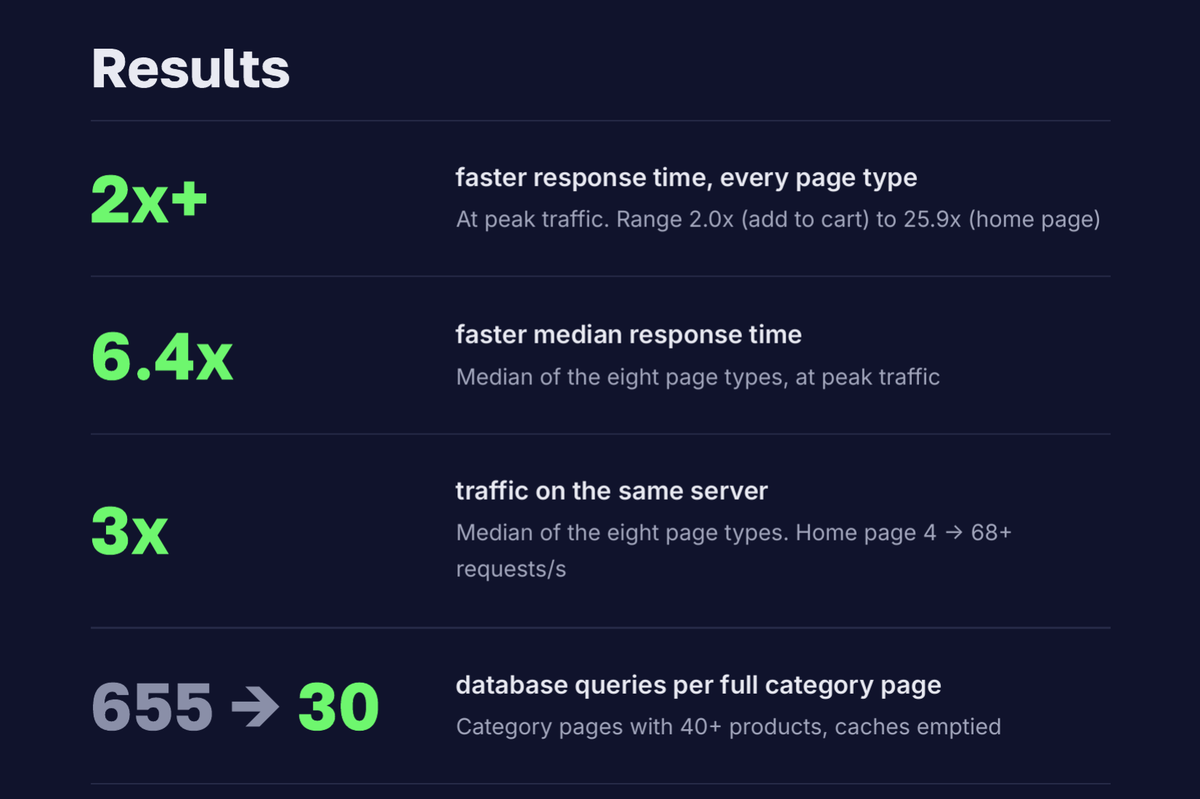
The report shares one design principle, which is that templates render and do not fetch. A template declares the data it needs, and the page gathers those declarations and loads the data in bulk before rendering starts. In the benchmark, a full category page with 40 or more products went from 655 database queries on stock Magento to 30 on Expedio.
What the Benchmark Measured
The report covers one merchant’s Magento store on Hyvä, with about 1,000 categories and 20,000 products. scandiweb ran the store as it exists and the same store on Expedio, on one ReadyMage server with the same hardware share, database, search and cache, and with no full-page cache. The runs took place on September 28 and 29, 2026, and total 162 runs and 487,115 requests.
At peak traffic, the report shows these results.
- Server response time improved on the eight page types tested, from 2.0x on add to cart to 25.9x on the home page.
- The median across those eight page types was 6.4x faster.
- The same server handled a median of 3x the traffic, and the home page went from 4 requests per second to more than 68.
- A category page answered in 19 ms on Expedio compared with 400 ms on stock Magento at 20 requests per second.
- The first request after a restart took 87 ms compared with 832 ms.
What the Benchmark Leaves Out
scandiweb lists the limits in the report itself, and those limits shape how the numbers read.
- The figures are server response times, and the report does not measure full page load in a browser.
- One merchant’s store was tested, with its own extensions and customizations. The release refers to benchmarks across dozens of stores, and the report says results from more migrated stores are coming.
- Cart and checkout are outside the comparison. scandiweb says they were not a focus of the first release.
- The server ran on ReadyMage, where stock Magento answered in 70 to 472 ms with no page cache, which the report calls faster than a typical store. Shared or slower hosting was not measured.
The report sent to press also contains no Shopify test data. The side-by-side Shopify comparison comes from the release and from the live demos, which scandiweb says let a visitor click through the same store before and after.
Open Source and Live Demos
scandiweb is releasing a standalone part of Expedio as open source, so developers in the Magento community can use those improvements without becoming ReadyMage customers. The company lists the live store demos and the open-source module as opening on October 6.
For the merchant, the report says the admin, catalog, prices, checkout, orders and storefront design stay as they are, on Hyvä or Luma.
What Magento Merchants Can Take From the Launch
A merchant weighing a move off Magento for speed has a new question to put to the hosting provider and the agency before signing a replatform contract, which is how long the server takes to answer a category page and a search page on a cache miss. Expedio’s numbers come from scandiweb’s own hosting and one store, so a merchant on other infrastructure can ask for a test on a copy of their store with their extensions installed, and can check cart and checkout apart from the published figures.
About scandiweb and ReadyMage
scandiweb describes itself as the most-certified Adobe Commerce agency, with more than 600 specialists and more than 894 Adobe certifications. The company is an Adobe Gold and Hyvä Platinum partner, was founded in 2003, and has worked with Magento since the platform launched in 2008. scandiweb reports more than 2,100 ecommerce projects for brands including PUMA, The New York Times and Samsung, and says the stores it supports process more than $4 billion in sales a year. The same team built ReadyMage in 2020 as a hosting platform made for Magento that combines hosting, security, scaling and ongoing support.