
Shopware Stands Alone as the Visionary in the 2026 Gartner Magic Quadrant for Digital Commerce
Gartner’s 2026 Magic Quadrant for Digital Commerce Platforms puts five vendors in the Leaders box, four in Challengers, four in Niche Players and one, Shopware, by itself in Visionaries, and the three strengths Gartner lists are the three bets the company has been making in public all year.
What does it mean when an analyst firm draws a box with four corners and leaves one corner to a single company? On October 22, 2026, Shopware published its placement in the 2026 Gartner Magic Quadrant for Digital Commerce Platforms, where it is the only vendor positioned as a Visionary. The quadrant, dated as of September 2026, plots 14 platforms. Shopify, Salesforce, commercetools, SAP and Adobe sit in Leaders. Kibo, VTEX, SCAYLE and Commerce, the company formerly known as BigCommerce, sit in Challengers. WooCommerce, Spryker, Intershop and Oro sit in Niche Players. Shopware sits alone in the lower right, high on completeness of vision and below the line on ability to execute.
Shopware was a Visionary in the 2025 report as well, which the company called its sixth consecutive year in the Magic Quadrant in November 2025, so 2026 makes seven. The difference in 2026 is the company around it. Nobody else is in the box.
The Three Strengths Gartner Names
Gartner’s strengths section for Shopware names three, and the wording below is Gartner’s.
- Agentic commerce vision. “Shopware demonstrates a forward-looking agentic commerce strategy through its native Agentic Commerce sales channel, MCP server, and UCP support, enabling merchants to publish structured feeds directly to AI surfaces like ChatGPT and Gemini.”
- Native B2B portal. “Shopware includes a B2B buyer self-service portal directly within its core commerce platform, featuring digital sales rooms for live video consultations, co-browsing, and in-session quote negotiations. B2B organizations can leverage these collaborative sales tools out of the box without licensing separate add-on modules.”
- Integrated admin AI Copilot. “The integrated Copilot acts as a context-aware administrative assistant capable of executing multistep operational workflows, including SEO generation, drafting promotion rules, and performing bulk variant updates. Operations teams can automate routine catalog, campaign creation, and reporting tasks directly within the administration panel, reducing manual overhead.”
The first of those is the one that explains the box. Shopware’s Agentic Commerce extension, which the company’s own documentation still marks as beta, lets an AI agent browse the catalog, build a cart, apply a promotion code, complete checkout and read order status through four transports, REST, Agent2Agent, an embedded checkout and the Model Context Protocol. The Universal Commerce Protocol support is what lets an agent discover a Shopware store without a custom integration, and the ChatGPT marketplace registration the docs describe is, for now, US only.
What a Lone Visionary Means for a Merchant
Gartner’s two axes are completeness of vision and ability to execute, and a Visionary by definition scores high on the first and lower on the second. Read plainly, Gartner is saying Shopware has the clearest picture of where commerce platforms are going, and has not yet proven it can deliver that picture at the scale of the five Leaders. A merchant choosing a platform in 2027 has to decide which of those two things matters more for the life of the contract.
I have argued on this show for most of the year that agentic commerce is where the platform fight moves next, and I sat across from Sebastian Hamann at Shoptoberfest in Nashville in September while he made the case for an open platform in that fight. Gartner has now put the same bet on paper. The B2B strength deserves the most weight from a buyer, because digital sales rooms and in-session quoting inside the core platform are the features a mid-market B2B seller otherwise buys from a second vendor, and the second vendor is where the integration budget goes.
The execution question is a fair one. Shopware is a Schöppingen company founded in 2000, with a US office in North Charleston and a partner channel that is still growing on this side of the Atlantic, and the agentic features Gartner credits are beta. A merchant evaluating the platform can ask for the production references behind each of the three strengths, and ask which of the agentic surfaces, ChatGPT or Gemini, has produced an order for a live store.
What Changed in the Quadrant
The 2025 report evaluated 19 platforms, by Shopware’s count in its press release. The 2026 graphic plots 14, and WooCommerce appears in it as a Niche Player. Adobe is placed in Leaders near the line between Leaders and Challengers, and Commerce is placed close to the center of the chart. Those positions come from Gartner’s published graphic, and the report’s own commentary on the other vendors is Gartner’s to publish.
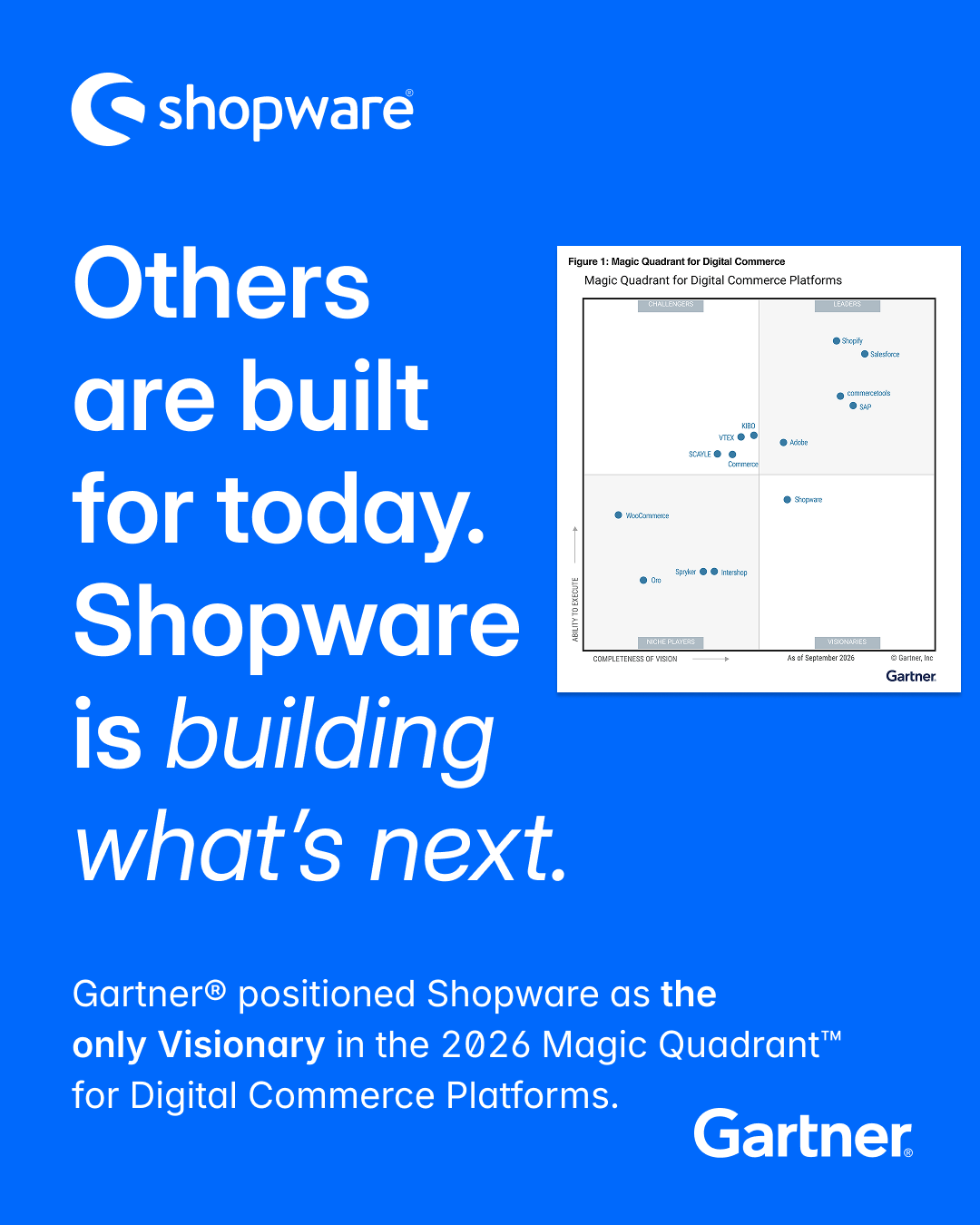
Shopware’s graphic for the 2026 placement, approved by Gartner for sharing, with the September 2026 quadrant.
The 2026 reprint is available through Shopware’s Magic Quadrant page. Gartner does not endorse any vendor, product or service depicted in its research publications, and the placements described here are Gartner’s, taken from its September 2026 quadrant graphic.