
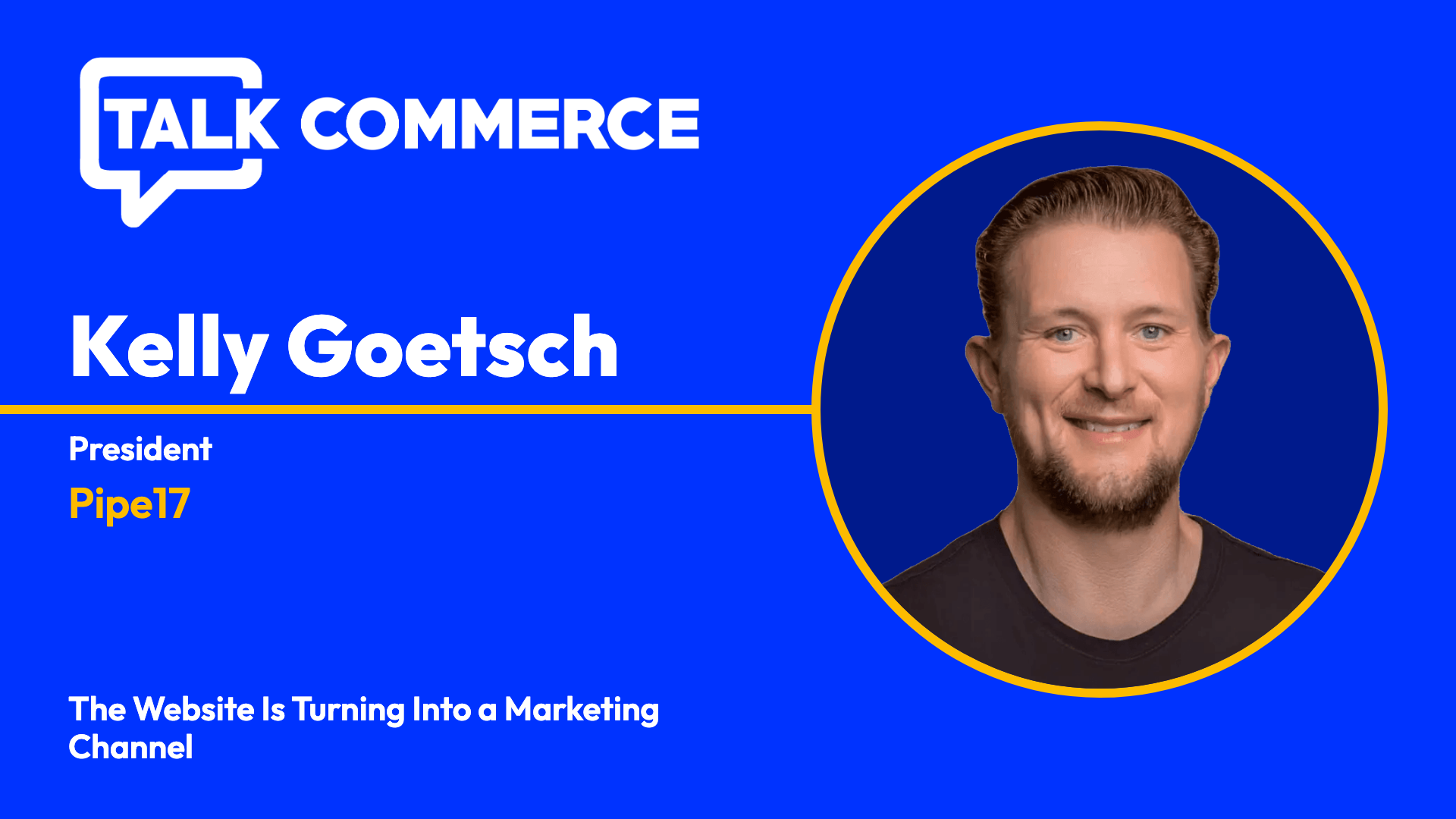
The Website Is Turning Into a Marketing Channel with Kelly Goetsch of Pipe17
Kelly Goetsch joined Brent Peterson on Talk Commerce from a week with his leadership team. Kelly is President of Pipe17 and the Commerce Operations Foundation, he started in eCommerce at Foot Locker in 2005, and he helped create the headless commerce category at commercetools. He rated the Free Joke Project a nine.
Plaid for eCommerce
Brent asked for the ten thousand foot view of Pipe17. Kelly went back to 2005, when Foot Locker sold through one channel, footlocker.com, and order management meant connecting the commerce platform to the ERP.
“And now over time, what we’ve seen is the proliferation of selling channels, and more than half of e-commerce now takes place off of the brand.com,” he says.
Five units of inventory listed on ten channels becomes a connectivity problem the moment one channel sells through. The old answer was an iPaaS gluing the channels together, which Kelly called fragile and brittle. Pipe17 built the network first.
“So the network is the core of the product. Think of it as like Plaid, but for e-commerce instead of financial services,” he says.
The network connects hundreds of selling channels, back office systems of record and fulfillment channels, 3PLs use it for inbound returns, and Pipe17 built enterprise order management on top of it as a drop-in replacement for Manhattan, Sterling, Kibo and Fluent.
The Website Is in a Long Slow Decline
Brent asked whether the website is going away. Kelly said the decline has started, and he listed the reasons, cookie consent banners, mailing list pop-ups and retail media.
“There’s a long slow decline that’s already starting to happen. And the web is increasingly a poor user experience,” he says.
His kids will do most of their shopping on a phone from links friends send, not through a shopping funnel.
“So the web is declining. It’s going to take some time. I think it’ll shift more into a marketing channel. And then the transactions are will be captured through, you know, Amazon for fulfillment, for example,” he says.
Who Controls What Shows Up
Brent pointed out that ads are already showing up on ChatGPT. Kelly said people who pay for a subscription get an experience that represents them, and that is a small group.
“We’re we’re part of the 0.00001% of the world’s population that are spending $200 a month on our cloud subscriptions, right? I think for everyone else, that’s where ads come in,” he says.
His example was a tent. On rei.com you use the tent finder. Inside an AI, the AI decides whether REI’s tents appear at all.
“If the web gets merged into an LLM, an AI head, now the OpenAIs of the world get to control who shows up,” he says.
The Dog Food Test
Brent described subscriptions where an agent shops around for the cheapest price. Kelly said it is good for consumers and a problem for retailers, and he has a purchase ready for it, a $110 bag of food for a 110-pound German Shepherd.
“I need this bag of dog food to show up on my doorstep the first of every month. Here’s how much I I will authorize the purchase. find the cheapest with the highest quality of service, I never want to think about buying dog food again,” he says.
The catch is that Amazon, PetSmart and Petco want the subscription, the relationship and the first party data, and an agent that consumes Amazon headless skips the ads, upsells and loyalty that Amazon sells.
“And if they just turn into a drop shipper, that’s a pretty low margin,” he says.
“I do know that this is the biggest upheaval in my career of twenty years so far,” he says.
Metcalfe’s Law Applied to an OMS
Brent asked why building on an OMS hurts. Kelly listed connectivity first. A traditional OMS integration is copied off the shelf and becomes yours to maintain, and every vendor changes its API.
“And you multiply that times 10 or 20 different connectors, you’ve suddenly got a very, very, very big problem,” he says.
Then Metcalfe’s law. Connections grow with the square of the nodes, so ten channels, two ERPs and three 3PLs add up, and some of those ERPs want EDI or flat files over FTP. The last problem is architectural. Traditional systems demand to sit in the middle.
“I think a more modern approach, which we’re pioneering, is we will happily allow a NetSuite or an SAP to be the system of record, and we’ll just be the connectivity layer that flows orders into whatever the system of record is,” he says.
Black Friday Without the War Room
Kelly does not expect a roller coaster this season. He was in the war rooms in his twenties, and the industry has run enough of these to know what breaks.
“Like we’re maturing as an industry. and when you combine all of that, it makes for a lot less drama,” he says.
Spend Face Time With Your Colleagues
For his plug Kelly asked for more humanity at work. He was with his leadership team in person that week.
“I think we have a tendency of just lobbing these AI slop bombs back and forth to each other and having Claude run our lives now. It’s a very cold mechanical way of doing things. It’s often wrong,” he says.
“So that’d be my plug is to actually spend face time with your colleagues, go eat and drink together, go have discussions in rooms, stop relying so much on AI,” he says.
Find Kelly on LinkedIn and Pipe17 at pipe17.com.
This episode is sponsored by Triple Whale. Get the Triple Whale BFCM Command Center at triplewhale.com/talkcommerce.