
Younger Pet Owners Cut Their Own Budgets Before They Cut Pet Spending
A new Harris Poll study finds younger pet owners cutting their own spending, and in some cases taking on debt, to keep investing in their animals.
When household budgets tighten, discretionary categories usually soften. Pet spending is doing the opposite. A new Harris Poll study, The State of Pets, surveyed 2,070 U.S. adults in April 2026 and found that 77% of Americans now own at least one pet, up three points since 2024. The more useful number for commerce operators sits underneath that headline. Among Gen Z and Millennial owners, pet spending is not the line that gets cut when money is tight. It is the line they protect by cutting everything else. That behavior turns the pet category into something closer to a fixed cost than a discretionary one, and fixed costs are where durable commerce gets built.
What the Data Shows
Ownership is broad. Dogs lead at 60%, cats follow at 45%, and 77% of Americans own some kind of pet. What separates the generations is not whether they own a pet but how they spend on one. Among Gen Z and Millennial owners, 77% say they keep a separate budget just for their pets, compared to 56% of Gen X and Boomers.
That separate budget shows up across nearly every category, and the generational gaps are wide. In an average month, 61% of younger owners spend on pet insurance versus 22% of older owners, a 39-point gap. Clothing runs 52% versus 22%, grooming 63% versus 43%, and training 36% versus 9%. Vitamins and supplements land at 70% versus 45%. These are not small premiums layered on top of food. They are recurring spend categories that barely register for older owners.
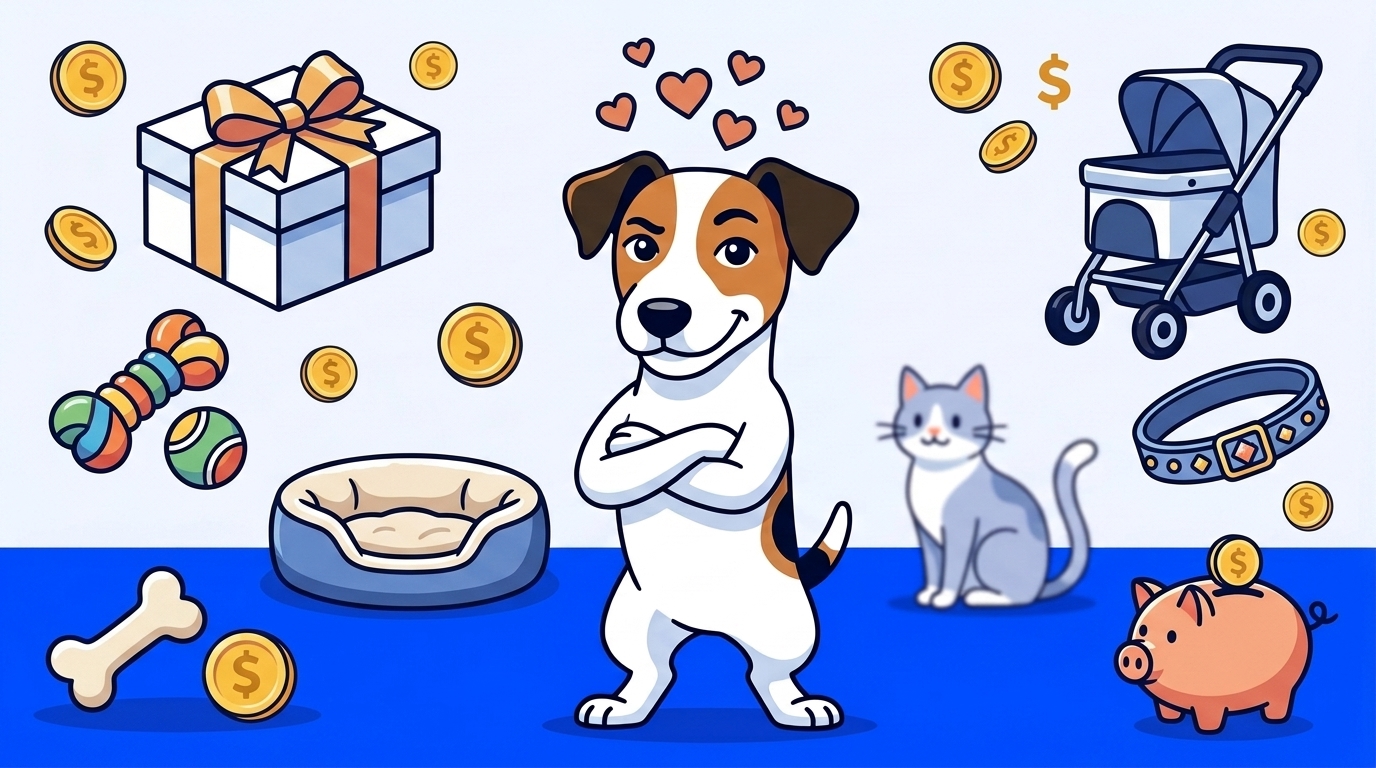
The premium end goes further than recurring care. Among Gen Z and Millennial owners, 49% have designed a specific part of their home for their pets, 41% have thrown a pet birthday party, 40% have bought a GPS tracker or collar, and 39% subscribe to a monthly toy and treat box. Roughly a third have bought a pet stroller, a pet camera, or designer pet clothing.
The tradeoffs funding all of this are the part worth sitting with. To afford pet expenses, 61% of younger owners cook at home more instead of ordering takeout, 46% switched to cheaper grocery brands for themselves, 45% cut back on their own comfort purchases, and 36% reduced the number of vacations they take. More striking, 28% delayed paying off debt, 27% canceled a gym membership, 26% moved to a smaller place, and 25% skipped or delayed their own medical appointments. Nearly three in 10 younger owners (29%) say they are facing debt as a result of pet expenses, versus 14% of older owners.
Why the Pet Line Gets Protected
The spending pattern tracks a shift in how younger owners define the relationship. Across all pet owners, 83% agree their pet is like their own child. When forced to choose what they would prefer to have in the future, 40% of Americans pick pets over children, ahead of the 21% who pick children. Over half of Gen Z and Millennials (55%) say they have thought about building a life around pets instead of having kids, and 54% would leave their pet their inheritance if they could.
That framing changes the spending logic. A dependent does not get cut from the budget when times get hard. It gets protected, and the cuts land elsewhere. The Harris Poll data shows exactly that mechanism at work. Owners are not spending more because they feel flush. They are holding pet spending steady, or growing it, while contracting their own consumption to make room.
The category also has a clear ceiling on substitution. 86% of pet owners say AI pets could never replace the emotional bond they have with a live animal. Whatever gets automated or synthesized in the coming years, the demand this study measures is anchored to a living animal that eats, ages, and needs care every month.
What This Means for Commerce
For operators, the read is straightforward. The pet category carries the demand profile every commerce team wants. It is recurring, emotionally protected, and concentrated in a younger cohort that is still forming its lifetime buying habits. When a customer will skip a personal medical appointment before skipping a pet purchase, retention and lifetime value in that category look very different from a discretionary one.
The subscription and insurance signals are the ones to act on first. A 39-point generational gap in pet insurance and a 39% subscription-box rate among younger owners both point to recurring-revenue models that this cohort has already accepted. Premiumization is the second signal. Owners buying strollers, cameras, custom home spaces, and designer clothing are telling you the ceiling on average order value is higher than the food-and-litter baseline suggests. And the appetite for future services runs ahead of what the market offers today. Among younger owners, 75% say they would pay for a drug that extends a pet’s life, 59% for pet trust fund management, and 57% for senior pet retirement centers.
The caution worth naming is the debt. With 29% of younger owners already in debt over pet expenses and 44% of all owners worried about affording care as costs rise, price sensitivity coexists with the willingness to spend. The brands that win this cohort will likely be the ones that make premium pet care feel financeable and routine rather than a splurge that adds to the debt load. Payment flexibility, subscription smoothing, and bundled care are the mechanics that meet the behavior the data describes.
As Libby Rodney, Chief Strategy Officer and Futurist at The Harris Poll, put it: “Paw-renthood has become a real economic and family identity. Asked what they’d prefer to have in the future, more Americans now choose pets over kids, and younger owners are cutting their own takeout, vacations, and even medical appointments to splurge on their animals. This isn’t sentiment. It’s a generation deciding the pet is the one dependent they can actually afford to raise.”
The full report is available from The Harris Poll at theharrispoll.com. The specific percentages will shift by industry and company, but the directional signal, that a younger generation is treating pet care as a protected household commitment rather than a discretionary one, is the kind of demand pattern that reshapes a category.