
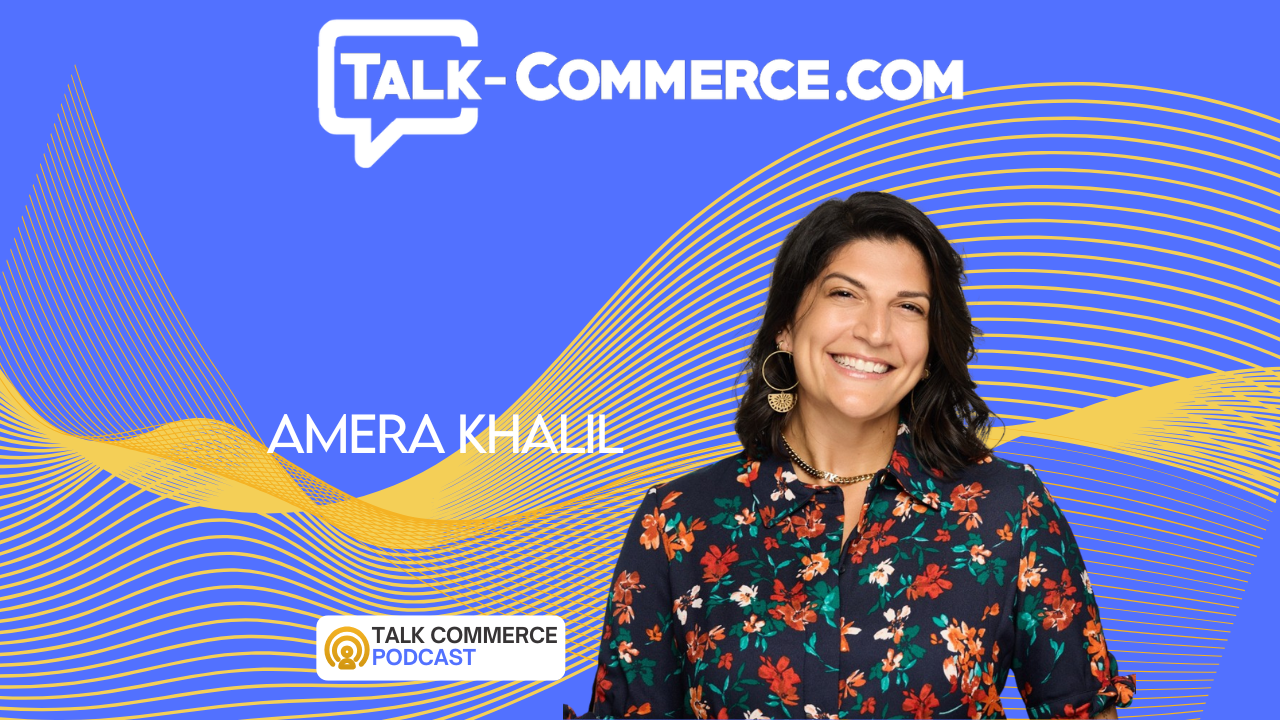
Live From Shoptalk: Getting Your Brand Ready for Agentic Commerce with Amera Khalil
By Isaac Morey
The e-commerce industry isn’t standing still, and neither is the Talk Commerce podcast. In this live episode recorded at Shoptalk Spring 2026 in Las Vegas, host Isaac Morey sat down with Amera Khalil, Director of Strategic Account Management at Commerce — the parent brand that brings together Feedonomics, BigCommerce, and MakeSwift under one roof.
Our conversation covered exactly what brands need to hear right now: how consumer discovery behavior is shifting toward AI-powered platforms, what data preparation actually looks like in practice, and why agentic commerce readiness isn’t just for enterprise brands. If you’ve been wondering whether your product data is ready for an AI-first world, this episode has some timely answers.
Key Takeaways
- Data quality is the foundation. Before any AI strategy works, your product feeds need accurate titles, descriptions, sizes, and attributes.
- Enriched data isn’t one-size-fits-all. Enrichment requirements vary by brand, category, and channel — and they need to match today’s conversational search queries.
- Agentic commerce is already operational. Commerce built a fully functional agentic checkout experience for PacSun on Perplexity in under 30 days.
- Don’t deploy AI for AI’s sake. Without a clear business objective, AI implementation creates confusion rather than results.
- SMBs need to act now. LLM visibility isn’t exclusive to enterprise brands — smaller businesses can start preparing today.
- Human oversight isn’t optional. Quality assurance guardrails protect brand integrity and keep AI-generated content on point.
- Have AI conversations out loud. Brands strategizing behind closed doors miss partners who may already have the solutions they need.
Episode Summary
Amera opened by describing Commerce’s three-brand structure. Feedonomics handles intelligent product feed management, BigCommerce powers flexible e-commerce experiences, and MakeSwift enables agile front-end design. She described Feedonomics’ core value simply: taking complex data, making it clean and structured, and distributing it intelligently across every relevant channel.
From there, Isaac asked the big question: how is AI changing e-commerce? Amera’s answer was direct. The traditional marketing funnel — performance ads, tracking, attribution models — is collapsing. Consumers are now using Perplexity, ChatGPT, and Claude not just for research but for actual purchase decisions. “The biggest change in e-commerce,” she noted, “is the preparation to be visible on these LLMs while maintaining the quality of your data.”
She broke agentic commerce readiness into clear layers. First, brands need solid foundational data — accurate product titles, descriptions, brand names, sizing. Without that, nothing else works. On top of that, brands need enriched data that responds to how people actually search today. Nobody’s typing “suitcase” anymore. They’re saying something like, “I’m going on a trip, I want something light, and I tend to overpack.” Product data has to meet that kind of specificity.
Interestingly, she was candid about the complexity of getting onto LLM channels: “Just because you’re a brand doesn’t mean that your feed is going to be accepted.” Approval processes are real hurdles, and the backend requirements — syncing inventory, enabling checkout, integrating payments — go well beyond what most marketing teams expect.
The PacSun case study was the episode’s standout moment. Commerce built a complete agentic checkout experience for PacSun on Perplexity in under 30 days, during the holiday season. Shoppers could find PacSun jeans, select their size, and check out via PayPal — receiving a confirmation email from PacSun directly. “This is thrilling,” Amera said, “because it’s changed the way that we are looking at our expectations as consumers.”
On AI risks, she stressed quality assurance. Feedonomics uses internal benchmarking systems that flag AI-generated content not meeting brand standards before it goes live. She also flagged a generational nuance: Gen Z consumers can detect cold, scripted AI content, and they don’t respond well to it. Adjusting content based on audience expectations isn’t a nice-to-have — it’s essential.
For SMBs, her advice was to start with a data audit. Centralize your assets, identify missing fields, and find a feed partner who can submit requests to LLMs on your behalf. As she put it, “even if you’re small, medium, or you’re the big kahunas in the industry, you have to be present and you certainly have to be visible.”
Final Thoughts
In this new era, AI agents act on behalf of shoppers — searching, comparing, and even checking out across multiple channels, often without ever visiting a merchant’s website. These AI-driven experiences are seamless, contextual, and increasingly the default for how consumers interact with commerce online. Amera’s message throughout this episode is clear: preparation beats hesitation every time.
So here’s the question worth sitting with — if your brand’s data isn’t ready for an agent to read it, how feed-y is your commerce strategy for what’s already here?
This has been produced in cooperation with Content Cucumber
https://www.contentcucumber.com/
Follow Talk Commerce on your favorite platform:
- YouTube: https://www.youtube.com/@talkcommerce
- Bluesky: https://bsky.app/profile/talkcommerce.bsky.social
- Apple Podcasts: https://podcasts.apple.com/us/podcast/talk-commerce/id1561204656
- Spotify: https://open.spotify.com/show/7Alx6N7ERrPEXIBb41FZ1n
- X: @talkingcommerce
- LinkedIn: https://www.linkedin.com/company/talk-commerce
- Facebook: https://www.facebook.com/talkingcommerce
- Website: https://talk-commerce.com/