
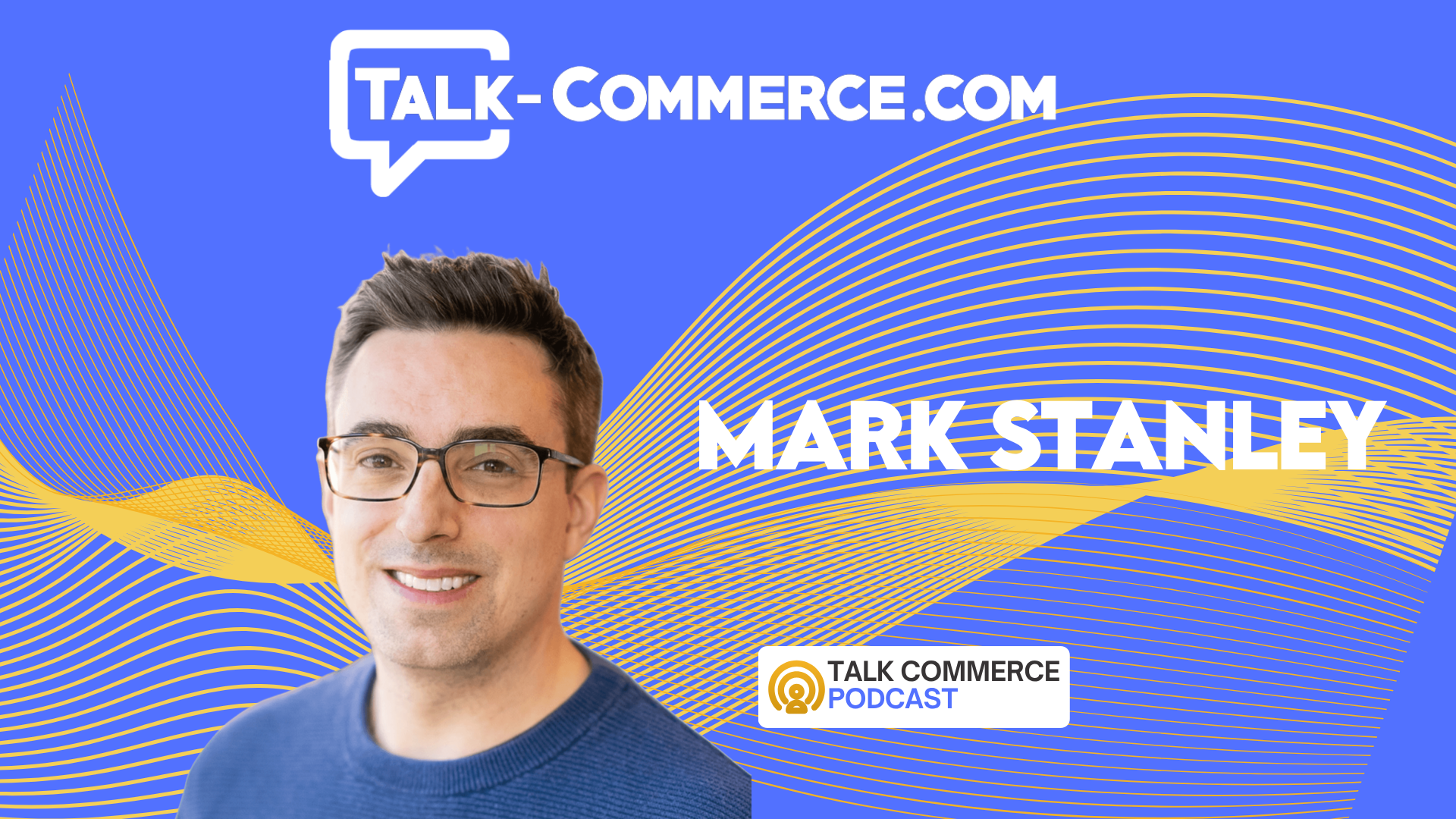
Recorded live at Shopware Partner Day in Austin, Texas on April 22, 2026.
We spent the day in Austin interviewing e-commerce experts for a report on the trends shaping B2B, and while we were there we sat down with Shopware’s chief product and technology officer, Mark Stanley.
Stanley looks after all product development at Shopware. He has a list of things shipping this year, and he has a hot take about what merchants ought to be protecting while everyone else is busy shipping. The second one is the more useful conversation.
The Moat Is the Thing an AI Cannot Copy
Asked for an e-commerce hot take, Stanley goes straight to ownership.
“There is going to be more SaaS providers that are going to want to hoover up as much information, as much data as they can possibly get,” he says. That trade works fine for a merchant who wants a simple button to push and for everything to work.
It works less well for the merchant thinking past this quarter. “For more long-term thinking merchants and those that really want more control of their business, they’re thinking more and more about data sovereignty and business model sovereignty, and they don’t want to just give that up.”
What they are protecting is location. Where the business model lives. Where the proprietary data sits. Whether either can be pulled into a model that was only ever in somebody else’s cloud.
Then the line worth writing down. “My advice and my hot take is think about what is important to your business, what is the thing you want to protect, and what you don’t want an LLM or an AI in two or three years’ time to be able to copy.”
His reasoning underneath it is that the ground has moved. “The moats are effectively changing.” He also points out that with new technology arriving, the big players are running the same play they ran in the early noughties after the dot com boom.
From Shipping Features to Delivering Outcomes
For partners and agencies, Stanley sees the job description changing.
“Often it’s been a game of shipping features or it’s been staying ahead of the competition or it’s been monetizing time, monetizing projects,” he says. “I think in the future it’s going to be much more about how can we deliver outcomes to people and customers.”
He expects the unit of measurement to follow, with tokens becoming the way outcome usage gets counted. That raises a harder question than the billing one. “How then do you judge whether the outcome you’ve got is really valuable? I think that’s the way that the whole tech industry is going to go in the future.”
The First 80 Percent
On where AI earns its keep today, Stanley is most interested in developer tooling, and he is specific about how far it gets you.
“That first 80 percent can be done in 20 percent of the time,” he says. Prototyping, trying something out, seeing whether it works, moving it to an MVP. All of that accelerates.
He is equally specific about the part that does not. “The last 20 percent still requires a lot of human work, getting the thing run, maintaining it, structuring it properly, and really forcing the AI to simplify things.”
On the consumer side he expects a split rather than a takeover. Some shopping stays tactile, digitally or physically. He uses Spotify to make the point. Asking Siri to play something is a different experience from wanting to browse, see the musicians, and compare. What he is watching for is where extreme automation finds product market fit on the consumer side.
An Underdog Ground Game in North America
Shopware is well established in Europe and new in North America, and Stanley frames that gap plainly.
“It’s an underdog story,” he says. “We are the Linux to the Windows, or we’re the Android to the iOS.”
The work in North America is relationships and community rather than positioning. The goal is a developer community the size of the European one, with contributions, plugins, apps and Nexus connectors being built, because that is the multiplier. He has done this before and describes the method without dressing it up. “It’s about bringing a case of beer, taking it, going on the road, being inclusive and getting people to join the ride.”
Why the Room Still Matters
Stanley makes the case for in-person events from first principles rather than from a marketing calendar.
“Ultimately, we are a human-driven society and a human-driven civilization,” he says. “We don’t want life to just be transactional.”
He ties it back to how Shopware builds. Being open source and community driven means the company gets better by making partners successful, and that runs both directions. Finding the real pain points takes being in a room together. “You have to listen to people. You have to really understand where the pain points are, where the problems are.”
What Is Shipping
Three things, at three different stages, and Stanley keeps them distinct.
Shopware’s own native PaaS has gone GA. It is highly opinionated, runs from the command line, spins up resources, takes the plugins and flexibility a project needs, and scales automatically. It sits alongside the PaaS options Shopware offers with partners rather than replacing them.
An intelligence suite is in progress, bringing AI into the day to day work. Bulk editing, generating CMS content, and pulling data insights out of what is happening in a store.
Nexus is the new one, an orchestration system for connecting Shopware instances to each other and to third party systems, with extensibility opening up to the partner network. It goes GA at Shopware Community Day in Cologne.
An Exciting Time to Be Alive
Stanley closes on the mood he wants the industry to take into the next few years, and it is not a defensive one.
“I don’t think people should see it as threatening or should take a sort of fearful view of it,” he says. “I think people should see it as an opportunity and an exciting time to be alive.”
He puts today’s models in a line of descent, standing on big data in the 2010s, on MapReduce, on deep neural networks. “There’s going to be a lot of interesting change and I think that’s a lot of opportunity for everyone to get excited about. Embrace it with open arms is what I would say.”
Shopware Community Day runs June 10 in Cologne. Shoptoberfest runs September 14 and 15 in Nashville.
Watch the full conversation on YouTube, or listen on the Talk Commerce podcast.
To learn more about our at-event interviews, go to talk-commerce.com/events.