
Healthcare Employers Cool on AI Skills as 70% of Gen Z Workers Look to Leave
The 2026 Healthcare Workforce Barometer from The Harris Poll finds healthcare employers less convinced that AI skills are critical than they were in 2025, and workers slow to trust the tools. The same survey shows 70% of Gen Z healthcare workers planning to look for a new job.
How fast is AI moving inside a workforce built around patient care? The 2026 Healthcare Workforce Barometer, conducted by The Harris Poll for Strategic Education, Inc. and its subsidiary Workforce Edge, surveyed 1,514 healthcare employees who provide direct patient care and 304 healthcare employers. The study arrives as the Health Resources and Services Administration projects a shortage of nearly 500,000 critical healthcare workers by 2038.
Employers Pull Back on AI Urgency
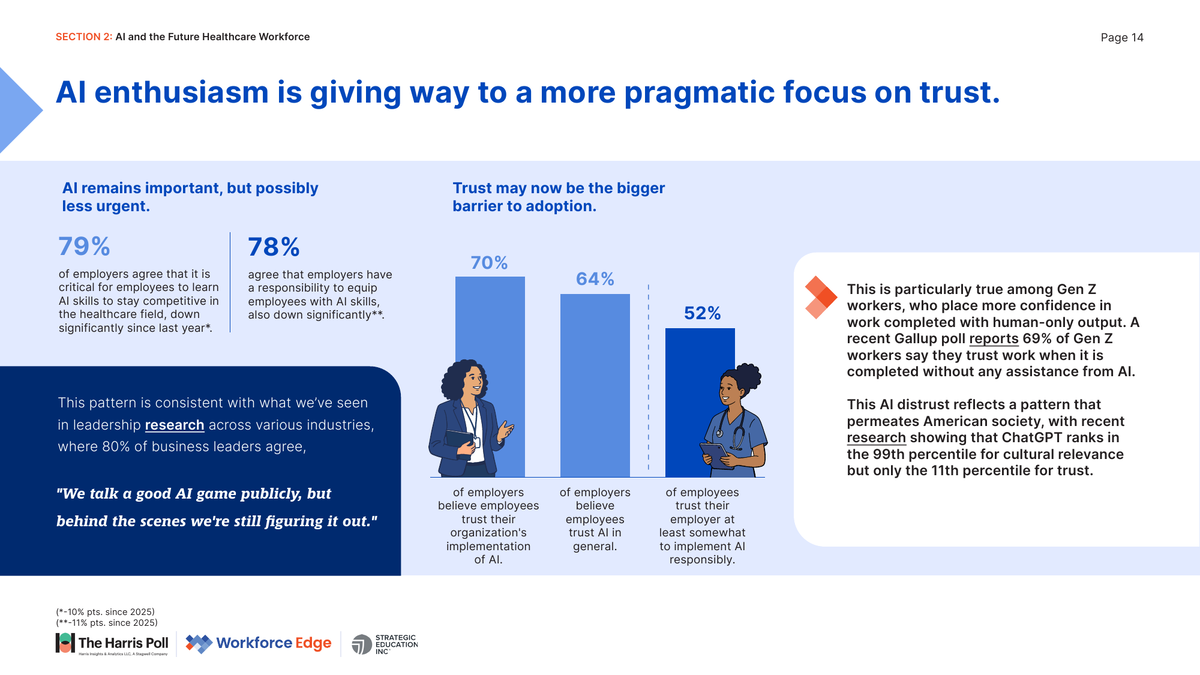
In 2025, 89% of healthcare employers agreed it was critical for employees to learn AI skills to stay competitive in the field. In 2026 that figure is 79%, a drop of 10 points. The share of employers who say they have a responsibility to equip employees with AI skills fell 11 points, to 78%.
Healthcare employees are cautious too, with 48% feeling comfortable using AI-based tools in their current role. Employers estimate that 45% of their employees are proficient with them. Among employees already experiencing AI at work, 28% say it helps them complete tasks more efficiently and 23% say it reduces administrative work. Thirty-nine percent of healthcare workers say AI has had no noticeable impact on their work yet.
The report frames the shift as AI enthusiasm giving way to a more pragmatic focus on trust. Seventy-two percent of employees and 85% of employers agree AI is becoming more important in healthcare while human oversight stays essential because of the nature of patient care. Forty-five percent of employees trust that AI will provide meaningful benefits to patients. Their leading concerns are the loss of human interaction at 40%, the accuracy or reliability of AI tools at 37%, and data privacy and security at 34%.
Seventy percent of employers believe employees trust their organization’s implementation of AI, and 64% believe employees trust AI in general. Among employees, 52% trust their employer at least somewhat to implement AI responsibly.
“These results suggest that both employers and employees recognize the value of preserving the human element in healthcare,” said Adele Webb, Healthcare Workforce Advisor for Workforce Edge. “While AI remains an important capability and can help streamline work and create efficiencies, the demands of patient care coupled with the need to protect sensitive health data require a more measured approach when it comes to implementing AI tools in clinical settings.”
Healthcare workers see their own jobs as better protected. Two thirds, 66%, believe that as healthcare workers they are less at risk of AI replacing their jobs entirely than workers in other industries, while Pew Research reports that 56% of US adults are extremely or very concerned about AI eliminating jobs.
What the AI Gap Looks Like Outside Healthcare
A commerce team rolling out AI to store associates or customer service agents can borrow both Harris trust questions, asking managers what they think the floor believes and asking the people using the tools directly. In healthcare the two answers came back at 70% from employers and 52% from employees, on questions worded differently. Employer urgency on AI skills also fell 10 points inside a single year once the tools reached the work.
Gen Z Workers Want a Path Up
Fifty-nine percent of the healthcare workforce is likely to look for, interview for or switch to a new role in the next year, and among Gen Z healthcare workers the figure is 70%. Gen Z workers still plan to settle down, with 65% expecting to stay with one employer for five or more years eventually and 95% valuing job stability and long-term security.
Eighty-nine percent of Gen Z workers say clear opportunities for advancement are important in their jobs, compared with 77% of older workers, and 86% believe education or learning new skills will help them move up.
“As a nurse and educator of more than 42 years, these findings confirm what I have seen first-hand. Younger healthcare workers are willing to move on if their employer doesn’t support their career trajectory,” Webb said. “Employers must develop a retention strategy that incorporates the learning and advancement opportunities this generation expects.”
A Trust Gap on Career Growth
Only 26% of healthcare employees have a great deal of trust that their employer will support their long-term career growth. Employers see the connection to turnover, with burnout and emotional fatigue the reason they select most often for why employees leave, at 51%. Forty-seven percent of employers point to a lack of opportunities for career advancement, professional development or education.
Seventy-five percent of healthcare workers are interested in continuing their education through degree programs, certifications or skills-based learning, and 81% would be interested in an employer-sponsored education benefits program. Among employers offering education benefits, 89% say those benefits improve retention and career mobility among the employees who use them, while 48% of all employers surveyed have a comprehensive workforce education strategy.
“The disconnect between what healthcare workers value and what they believe their employers will provide is striking. Employees are looking for opportunities to grow and advance, and employers themselves recognize that a lack of those opportunities can drive people to leave,” said Jennifer Musil, Global President of Research, The Harris Poll. “The findings point to a clear opportunity for employers to strengthen retention by making professional development and education a more meaningful part of their workforce strategy.”
Methodology
The Harris Poll conducted the research online in the US on behalf of Strategic Education, Inc. and its subsidiary Workforce Edge, among 1,514 healthcare employees aged 18 and older employed full-time in healthcare and providing direct patient care in care-giving roles, and 304 healthcare employers aged 21 and older employed full-time in healthcare and providing direct patient care in director or higher roles. The survey ran June 12 to July 1, 2026. The full 2026 Healthcare Workforce Barometer is available from Workforce Edge.
About The Harris Poll
The Harris Poll is a global public opinion and market research firm and a Stagwell company. Workforce Edge, a subsidiary of Strategic Education, Inc., helps employers build education strategies and learning pathways for their workforce.