
In-Car Payments Are Gaining While Built-In Navigation Loses Ground
The technologies gaining fastest in The Harris Poll’s new automotive study are the ones that connect a vehicle to the accounts and devices a buyer already uses. The ones losing ground are the ones automakers built to stand alone.
Vehicle technology stopped being a spec-sheet line item and became a retention mechanic, and the 2026 AutoTECHCAST study from The Harris Poll puts a number on how far that shift has traveled. Seventy-nine percent of Gen Z and millennial vehicle owners say the technology in their vehicle makes them more likely to buy from that brand again, up 14 percentage points since 2016. The finding sits inside an annual tracking study now in its third decade, covering 40 emerging technologies and more than 10,000 US consumers, and the detail worth the attention of anyone who sells anything sits a layer below that headline, in the momentum scores showing which specific technologies gained ground in the 2026 wave and which lost it, because the split runs along a line commerce operators will recognize immediately.
What the Data Shows
Technology now carries measurable weight in the purchase decision itself, and the generational spread is wide. Seventy-eight percent of Gen Z and millennial buyers say in-car technology played a large role in choosing their current vehicle, a jump of 20 percentage points since 2016. Gen X sits at 63%, up 16 points. Boomers sit at 44%, up 8 points. Every cohort moved in the same direction. The younger ones moved further and started higher.
The loyalty measure follows the same shape. Gen Z and millennials report 79% agreement, Gen X 72%, and boomers 61%, with gains of 14, 15, and 6 percentage points respectively since 2016. A technology story that once belonged to early adopters now describes the majority of every age group Harris measured.
The momentum scores are where the study earns its keep. AutoTECHCAST plots year-over-year movement for each of the 40 technologies it tracks, sorting them into good, fair, and poor bands. Five technologies landed in the top band. Fully self-driving vehicles posted the strongest movement, followed by in-car payment systems, extended-range electric engines, smart home ecosystem integration, and panoramic displays. Front passenger screens sat just below them at the top of the middle band.
In-car payment carries a wrinkle worth naming, because it sits near the bottom of the study on familiarity at 40%, fourth lowest of the 40 technologies measured, while simultaneously posting one of the largest familiarity gains at seven points year over year. Rising quickly from a small base is a different planning problem than broad adoption, and it is the profile of a technology arriving rather than one that has arrived.
Three technologies landed in the bottom band, and all three are features automakers have spent serious money installing. Factory-installed dashcams and built-in media and navigation functionality posted the weakest movement of the group, with full digital display rear-view mirrors close behind. Harris tracks smartphone-linked media and navigation, meaning Apple CarPlay and Android Auto, as a separate line item from the built-in stack.
Why the Winners Look Like Ecosystem Plays
Group the risers and a pattern shows up that has nothing to do with how advanced any of them are. In-car payment systems extend a wallet the buyer already has. Smart home ecosystem integration connects the vehicle to a home the buyer already automated. Harris also tracks smartphone as key, which turns a device already in the pocket into the thing that opens the door. None of these ask the driver to adopt anything. They ask the vehicle to join something already running.
Now group the decliners. Built-in media and navigation is the automaker’s own stack competing against the phone in the cupholder. A factory-installed dashcam is a standalone device with its own storage and its own retrieval workflow. A digital rear-view mirror replaces something that already worked. Each one asks the buyer to use the manufacturer’s version of a thing instead of the version they already own and understand.
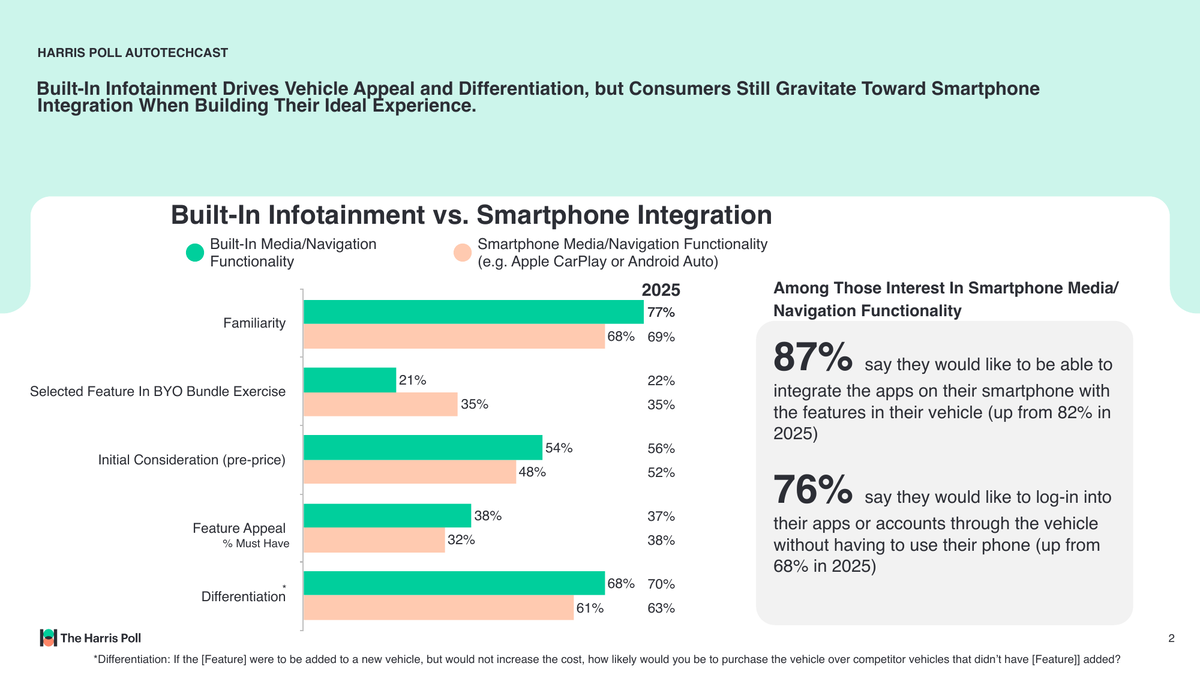
Harris puts this comparison head to head in supplementary material, and the numbers there are sharper than a story about one stack beating another. Built-in media and navigation carries the highest familiarity of any technology in the study at 77%, and it beats smartphone integration on initial consideration at 54% to 48%, on feature appeal at 38% to 32%, and on differentiation at 68% to 61%. Then the Build Your Own exercise attaches a budget and forces a tradeoff, and built-in media and navigation is selected into 21% of bundles against 35% for smartphone integration. It wins every measure of stated preference and loses the one measure that costs the respondent something to answer.
The study goes past stated interest into what people will pay for. A “Build Your Own” exercise makes respondents assemble a technology bundle under constraint, which surfaces price sensitivity and forces the tradeoffs that a simple interest ranking hides. Asking whether someone wants a feature and asking which features they will give up to get it produce different answers, and the second question is the one that maps to a product roadmap.
What This Means for Commerce
The first implication is that the vehicle is turning into a transaction surface, and in-car payments rising into the top momentum band is the clearest signal in the study. A car that can pay for fuel, charging, parking, drive-through, and tolls without the driver reaching for anything is a new checkout context, with its own identity, its own stored credentials, and its own attribution problem. Any merchant with a physical footprint a car pulls into has a channel question to answer here that did not exist a few product cycles ago. Who owns the customer relationship when the vehicle itself completes the transaction, the merchant, the automaker, or the payment network sitting between them? The demand side of that question is already measured. Among respondents interested in smartphone media and navigation, 76% say they want to log into their apps or accounts through the vehicle without having to use their phone, up from 68% in 2025, and 87% want their phone’s apps integrated with the features in the vehicle, up from 82%. Account identity is moving into the dashboard ahead of the checkout that will depend on it.
The second implication is about where the loyalty gets earned. When 79% of younger buyers say technology drives repurchase, the software experience has become a retention lever inside a category that historically treated the sale as the end of the relationship. That is the subscription logic every commerce operator already knows, arriving in an industry whose customer contact after delivery has mostly meant service appointments.
The third implication is the one that generalizes furthest past automotive. The technologies losing ground share a trait that has very little to do with engineering quality, since each of them arrived to compete against something the customer already owned and already knew how to operate. A brand that builds its own version of a solved problem is asking the customer to abandon a working habit, and the momentum scores suggest customers decline that trade with some consistency. The question that decides it is plain enough to ask in a planning meeting. What does the customer get from our version that they do not already get from the one in their pocket?
“Vehicle technology is playing an increasingly important role in brand growth – especially for younger buyers who judge a car the way they judge a smartphone,” said Gregory Paratore, VP of Insights and Analytics at The Harris Poll. “AutoTECHCAST shows automakers exactly which innovations will win consumer loyalty, years before they hit the mainstream.”
AutoTECHCAST fielded between April 8 and May 11, 2026, surveying more than 10,000 US residents aged 18 to 80 who hold a valid driver’s license, drive a 2020 or newer eligible North American model, carry at least half the decision weight on their next vehicle, and intend to purchase or lease. Data is weighted by demographics and by segment to represent the in-market vehicle buying population. The study is a multi-client commercial research product, so the technologies it tracks reflect what its subscribers pay to understand, and the momentum bands are relative to the 40 technologies in the set rather than to the whole market.
The full AutoTECHCAST 2026 report is available from The Harris Poll.
About The Harris Poll
The Harris Poll is a global public opinion and market research firm and a Stagwell company. AutoTECHCAST is its annual US automotive technology tracking study, running more than 20 years and covering 40 emerging technologies across driver assistance, comfort, connectivity, convenience, visibility, driver monitoring, powertrains, and vehicle security, with deep-dive sections on electric vehicles, autonomous vehicles, the connected car, and future mobility.