
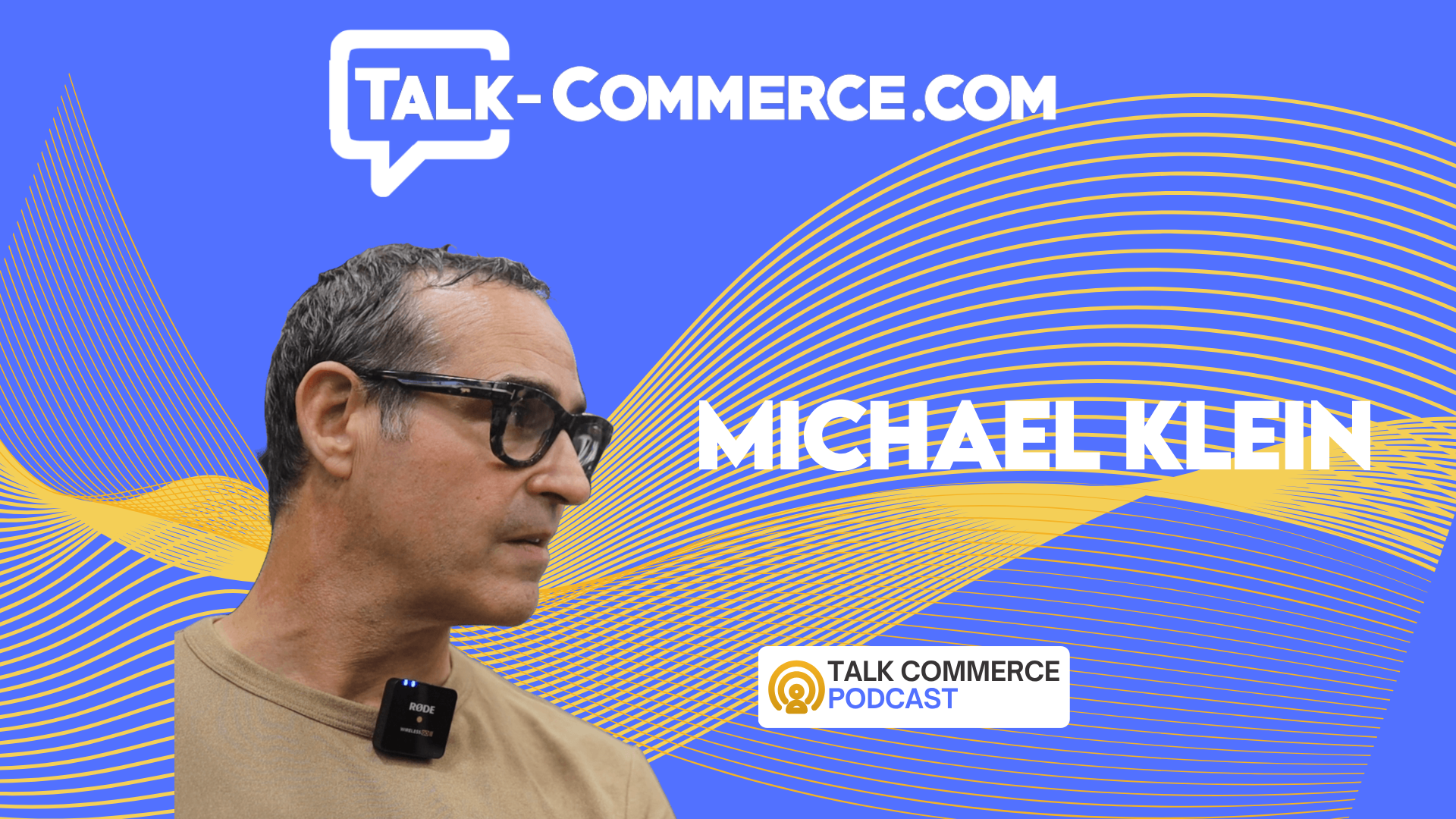
AI Customer Service and the Death of the IVR with Michael Klein of Talkdesk
I caught Michael Klein in the podcast area on the floor at The Lead Summit in New York, on the one day of the two he was available. He is the director of industry marketing at Talkdesk, where he owns the messaging for retail, travel, and consumer goods, and he has spent his career at what he calls the intersection of retail and technology. We had about eleven minutes and the conversation stayed on one question the whole way through, which is where the machine stops and a person picks up.
Contact Center Software That Grew Up
Talkdesk started somewhere narrower than where it sits now, and Michael put the arc in a sentence.
“So Talkdesk, our legacy is in contact center software. But we started building out our AI almost 10 years ago. And now we are a full CX platform where we help retailers before, during, and after the sale. Everything from product discovery all the way through to returns, recalls,” he says.
He named Michaels, Rocky Brands, Serta Simmons Bedding, and Ashley Furniture among the retailers they work with, said outbound capabilities are launching, and added that clienteling has a few initial use cases lit up with more coming.
“We’re making life better for both customers and the retailers that serve them,” he says.
The Death of the IVR
The phrase is his, and it is the one I keep thinking about. He is talking about the phone tree, the thing every one of us has been trapped inside.
“The dreaded you call in and you have to go through a tree of very intent-based prompts of push one, push nine, push all these buttons in order to get to the right queue,” he says.
What replaced it, in his telling, is a system that listens to the sentence instead of the keypad.
“Where today our natural language processing and our voice can actually understand what a customer is asking for without even having to push a button and getting them to the right queue,” he says.
His example is a large concierge and hospitality customer in Europe, a high touch business where plenty of people still want to pick up a phone and reach a person. Talkdesk routes those callers off the first thing they say.
“We’re helping them get to the right human based on what their first voice prompt is and they never have to push a button,” he says.
The Time I Asked Four Times
I told him about a company I left. Their AI agent would not hand me to a person. I asked four times, got nowhere, and canceled the service, and what stung is that this was a company known for good service before the bots arrived.
He did not defend the category.
“Well, I think to your point, our best practice recommendations is that it can’t just be a hundred percent AI, it can’t just be a hundred percent bot, because there will always be a percentage of your customer base that for whatever reason you need to be able to include the human at some point in time,” he says.
Then he told me he had the same experience, which I appreciated more than a rebuttal.
Optimizing the Hybrid Workforce
This is the framing he was taking to stage three the next morning, and it has two halves that face opposite directions.
The outward half is what a customer touches. Automation carries the friction people want gone, order status and returns and the rest, and the platform pulls context from a data cloud underneath it so the answer fits the person asking.
“So it’s not just one size fits all, and the beauty of AI and the beauty of the computing capabilities we have today is that we can do that in milliseconds,” he says.
The part he kept coming back to is when the automation steps aside.
“It still is very important to be able to bring the human into the conversation at that moment of truth when a customer or consumer wants to bring the human in and make that a personalized experience,” he says.
The inward half points at the staff. Store associates and contact center agents get the same context fed to them on a device or a dashboard, so the person picking up the thread knows what has already happened in it.
“All of that leads to a better, more personalized experience because of the ability to assemble that information and deliver it either to a consumer or to an associate at the moment of truth,” he says.
Where the Guardrails Go
I asked about slippage. Ten years ago a machine learning system did the same thing nearly every time, and the models we all use now will do the same thing ninety nine times and then say something strange on the hundredth. So I wanted to know what holds the line.
His answer started with what the system is allowed to read.
“So again going back to best practices, the data that we’re using for our AI, we’re not going out to the other LLMs. So that is the data that the customer provides us, and we’re only leveraging that, which is very important,” he says.
From there it is boundaries on where data travels, internal QA, and a testing pass before anything reaches production, which he says is how they keep hallucinations out of a live queue.
The Conversation Missing From the Stages
I asked for a hot take on the rest of the year and he gave me one about the agenda itself.
“Well I think we’re at this very interesting inflection point in terms of how people define agentic commerce and the orchestration of agentic commerce. So I’m interested to see how this evolves,” he says.
That is the part he is watching. The part he wants and is not getting is the other side of the ledger.
“When I’m at events like this, I would like to hear more about governance around privacy and transparency. Because we’re talking a lot about the bright and the shiny and all the great things we can do with product discovery and with different LLMs and being able to automate this and that, but I don’t think I’m hearing enough around the governance, the guardrails, because there are still a healthy percentage of consumers that are skeptical of AI and we’re gonna need to address those issues in order to really get increased adoption of these tools and these capabilities,” he says.
I have sat through a lot of keynotes this year and I think he is right about the balance. The demos are getting better and the disclosure conversation is roughly where it was.
Michael Klein is the director of industry marketing at Talkdesk, covering retail, travel, and consumer goods. This one was recorded on the floor at The Lead Summit in New York, so pardon the room.